Managing Plantar Fasciitis: Different Sex, Different Protocol
Thomas Michaud, DC
WHAT YOU NEED TO KNOW
Though rarely discussed, plantar fascial injuries are significantly more common in women.
While men respond favorably to calf stretches, women need alternate stretches that specifically focus on lengthening their plantar fascia in isolation.
Because arch muscles reduce fascial tension during gait, strengthening them benefits both sexes: helping prevent chronicity in women and reducing injury risk in men.
The plantar fascia is a broad sheath of connective tissue that stabilizes the medial arch during the gait cycle. As the foot contacts the ground, it stretches to store and return energy, offloading nearby muscles. During propulsion, it transfers force from the Achilles tendon into the ground, stabilizing the midfoot by preventing the arch from collapsing. The plantar fascia is one of the strongest tissues in the body, capable of withstanding tensile forces exceeding 3.7 times body weight with each running stride.1
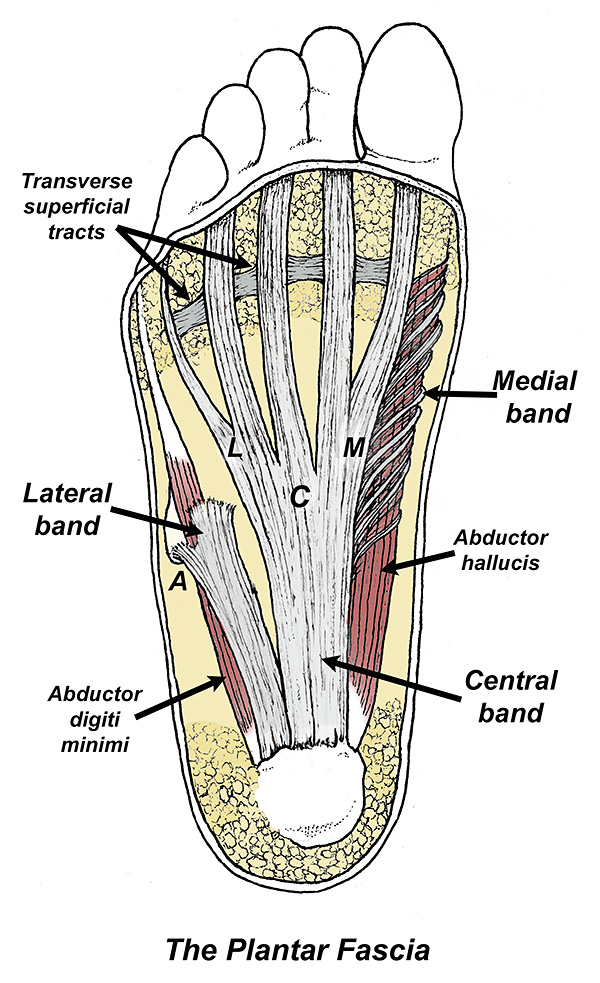
FIG 1
The plantar fascia’s inherent strength comes from parallel type I collagen fibers organized into three bands. (Fig. 1) Of these components, the central band is by far the thickest and strongest; however, its lack of elasticity makes it susceptible to injury and microtearing, particularly at its proximal attachment to the calcaneus.2 Despite this resilience, plantar fascial disorders affect over 10% of the population, resulting in more than 2 million doctors’ visits annually.3
A Sex-Based Injury Gap
Though rarely discussed, plantar fascial injuries are significantly more common in women, as a six-year study of over 130,000 people showed that females are nearly twice as likely to develop this frustrating injury.4 Even worse, a 15-year study by Hansen, et al.,5 found that women are more likely to develop chronic plantar fascial pain as they respond less favorably to conventional plantar fascial treatment programs.
The authors offered no clear explanation for the sex-based differences in injury frequency and chronicity, attributing them vaguely to “hormonal, physical, shoe wear, or some other factor.”
To better understand women’s greater susceptibility, Shiotani, et al.,6 used shear wave ultrasound to assess sex differences in plantar fascial mechanical properties and found that women have notably stiffer plantar fascias throughout the entire structure, not just at the proximal attachment.
The authors speculate that because women have weaker arch muscles, which normally offload the plantar fascia during propulsion, they place greater stress on the plantar fascia due to inadequate muscular stabilization, leading to chronic injury, adhesions and reduced flexibility.
In a follow-up study evaluating plantar fascial and Achilles tension in males and females, Shiotani, et al.,7 performed MRIs on 20 men and 20 women in a device specifically designed to measure tension in the Achilles and plantar fascia as the foot and ankle were moved into a dorsiflexed position. Using this detailed analysis, the authors found that men have significantly stiffer Achilles tendons with more compliant plantar fascias, while women have stiffer plantar fascias with more flexible Achilles tendons.
Since stiffer tissue fails more easily under load, this helps explain why women are more prone to plantar fascia injury while men are more prone to Achilles injury.
Why Calf Stretches Aren’t Enough for Women
The clinical significance of Shiotani’s research is huge, as the most commonly applied intervention for managing plantar fasciitis is to restore ankle mobility with calf stretches. These stretches will not alter plantar fascial tension in women because their overly flexible Achilles tendons will absorb force that would otherwise have gone into stretching the plantar fascia.7 As a result, conventional calf stretches will increase Achilles flexibility in women (which is not necessary) but will not alter tension in their chronically tight plantar fascias.
While men respond favorably to calf stretches, women need alternate stretches that specifically focus on lengthening their plantar fascia in isolation.
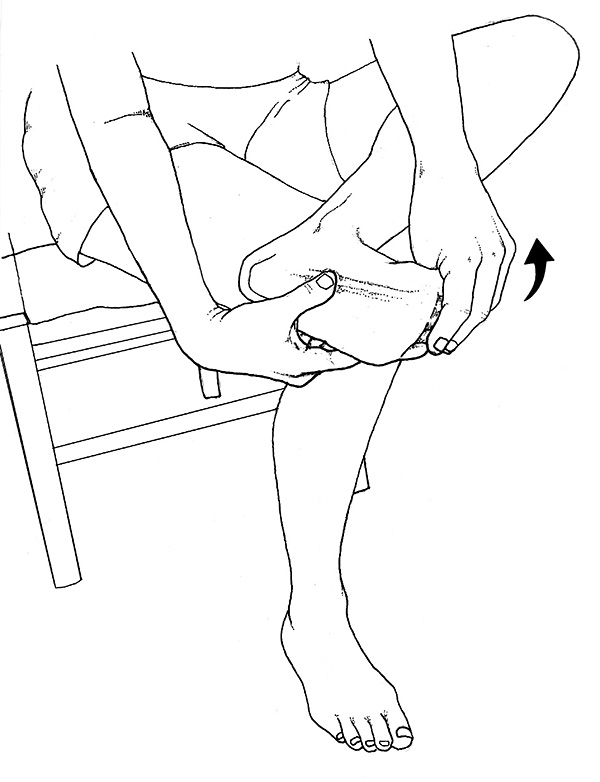
FIG 2
DiGiovanni, et al., 8 demonstrated this in 2003: A plantar fascia-specific stretch outperformed standard calf stretching across 101 chronic plantar fasciitis patients; greater pain reduction (83% vs. 58%), better functional improvement (50% vs. 11%), and higher satisfaction (91% vs. 61%). (Fig. 2) Despite DiGiovanni’s impressive outcomes, no studies have been done to determine if there are alternate stretches that might more effectively improve plantar fascia flexibility.
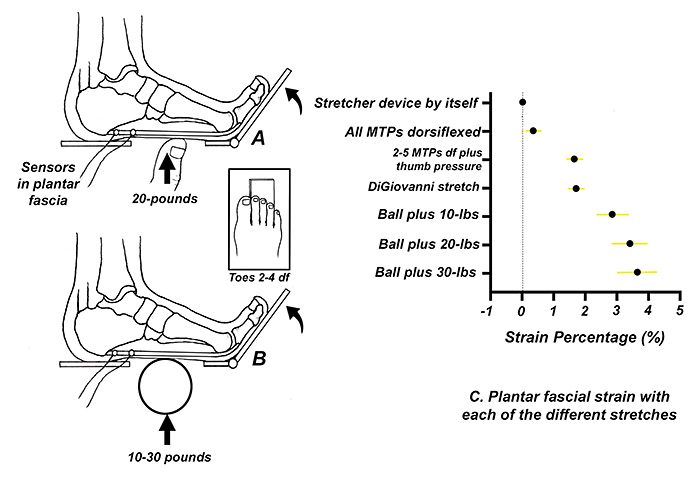
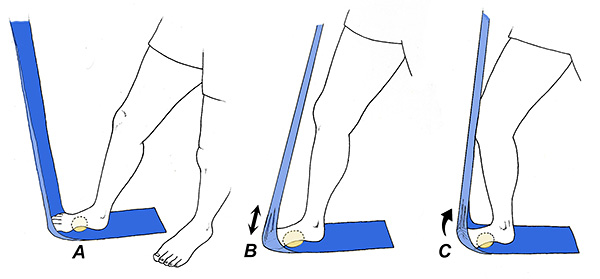
In 2026, researchers from Boston9 embedded strain gauges into 12 cadaveric plantar fascias and evaluated a series of alternate plantar fascial stretches. (Fig. 3) The DiGiovanni stretch produced modest lengthening of the plantar fascia by adding 20-30 pounds of axial load through a small ball positioned beneath the midfoot nearly doubled plantar fascial elongation. The results of this study suggest that the best way for women to reduce stiffness in their plantar fascias is with the stretch illustrated in figure 4.
FIG 3
What Men Need Instead
While targeted plantar fascial stretches are crucial when treating women with plantar fasciitis, men should prioritize improving medial gastrocnemius and Achilles tendon flexibility without overloading the plantar fascia.
Calf tightness, specifically tightness of the medial gastrocnemius, is a proven predictor of plantar fasciitis because it forces the heel to leave the ground prematurely, which greatly stresses the central band of the plantar fascia.10-11
FIG 4
As demonstrated in a cadaveric study by Ballal, et al.,12 tightness of the medial gastrocnemius increases the potential for plantar fasciitis because there is a continuation of medial gastrocnemius fibers through the Achilles tendon directly into the plantar fascia. As a result, tightness of the medial gastrocnemius is transferred almost immediately into the plantar fascia following heel lift.
When calf tightness is present, long-duration calf/Achilles stretches are the most effective remedy. Panidi, et al.,13 found that performing long-duration calf stretches five days a week for 12 weeks improves ankle dorsiflexion by a remarkable 22%. This dramatic increase in ankle motion appreciably offloads the plantar fascia, as the heel no longer leaves the ground prematurely.
Strengthening for Both Sexes
Because arch muscles reduce fascial tension during gait,14 strengthening them benefits both sexes: helping prevent chronicity in women (by offloading the fascia post-stretching) and reducing injury risk in men (by stabilizing the fascial origin at heel lift). Sullivan, et al.,15 suggest that people with plantar fasciitis are more likely to present with significant weakness of the peroneals and flexor digitorum brevis, so it is important to design an exercise program that targets these important muscles.
Toward Individualized Care
By creating an individualized treatment protocol that addresses the male-female differences between Achilles tendon and plantar fascia tension, it may be possible to improve clinical outcomes associated with this frustrating and difficult-to-treat condition.
Of course, alternate interventions should also be considered, as a 2026 systematic review found that soft-tissue massage improved clinical outcomes in people with chronic plantar fasciitis.16 Although not addressed in that study, it is likely that women are more likely to respond to soft-tissue manual therapy applied to the plantar fascia, while men are more likely to respond to aggressive massage of the medial gastrocnemius.
Interestingly, the authors state that in all of the studies included in their systematic review, manual therapy was most effective when coupled with stretching and strengthening exercises.
References
Shiotani H, Mizokuchi T, Yamashita R, et al. Acute effects of long-distance running on mechanical and morphological properties of the human plantar fascia. Scand J Med Sci Sports, 2020 Aug;30(8):1360-8.
Draghi F, Gitto S, Bortolotto C, et al. Imaging of plantar fascia disorders: findings on plain radiography, ultrasound and magnetic resonance imaging. Insights Imaging, 2017 Feb;8(1):69-78.
Tong KB, Furia J. Economic burden of plantar fasciitis treatment in the United States. Phys Ther, 2010;8(11).
Scher CD, Belmont Jr LC, Bear MR, et al. The incidence of plantar fasciitis in the United States military. JBJS, 2009 Dec 1;91(12):2867-72.
Hansen L, Krogh TP, Ellingsen T, et al. Long-term prognosis of plantar fasciitis: a 5-to 15-year follow-up study of 174 patients with ultrasound examination. Orthopaedic J Sports Med, 2018 Mar 1;6(3).
Shiotani H, Yamashita R, Mizokuchi T, et al. Site-and sex-differences in morphological and mechanical properties of the plantar fascia: a supersonic shear imaging study. J Biomechanics, 2019 Mar 6;85:198-203.
Shiotani H, Takahashi K, Honma Y, et al. Mechanical linkage between Achilles tendon and plantar fascia accounts for range of motion of human ankle-foot complex. Med Sci Sports Exerc, 2022 Aug 12;55(1):66.
DiGiovanni BF, Nawoczenski DA, Lintal ME, et al. Tissue-specific plantar fascia-stretching exercise enhances outcomes in patients with chronic heel pain: a prospective, randomized study. JBJS, 2003 Jul 1;85(7):1270-7.
Momenzadeh K, Williamson PM, Williams C, et al. Cadaveric analysis of plantar fascia strain and the development of a plantar fascia stretching device. J Biomechanics, 2026 Apr 26:113320.
Arshad Z, Aslam A, Razzaq MA, Bhatia M. Gastrocnemius release in the management of chronic plantar fasciitis: a systematic review. Foot Ankle Int, 2022 Apr;43(4):568-75.
Pearce CJ, Seow D, Lau BP. Correlation between gastrocnemius tightness and heel pain severity in plantar fasciitis. Foot Ankle Int, 2021 Jan;42(1):76-82.
Ballal MS, Walker CR, Molloy AP. The anatomical footprint of the Achilles tendon: a cadaveric study. Bone Joint J, 2014 Oct 1;96(10):1344-8.
Panidi I, Bogdanis GC, Terzis G, et al. Muscle architectural and functional adaptations following 12-weeks of stretching in adolescent female athletes. Front Physiol, 2021 Jul 16;12:701338.
Fessel G, Jacob HA, Wyss CH, et al. Changes in length of the plantar aponeurosis during the stance phase of gait–an in vivo dynamic fluoroscopic study. Ann Anat, 2014 Dec 1;196(6):471-8.
Sullivan J, Burns J, Adams R, et al. Musculoskeletal and activity-related factors associated with plantar heel pain. Foot Ankle Int, 2015 Jan;36(1):37-45.
Jawade SS, Jawade SA, Bankar N, Vardhan V. Effectiveness of soft tissue manual therapy in managing chronic plantar fasciitis: a systematic review. J Manip Man Ther, 2026 Mar 26:1-8.
While cervical disc pathology can unquestionably produce radiculopathy, many patients presenting with arm pain, paresthesia or perceived weakness do not exhibit the clinical behavior of true nerve-root compromise. In these cases, failure to differentiate the primary pain generator may lead to unnecessary spinal injections, nerve ablation procedures or surgical consultation despite limited likelihood of benefit.
The New Jersey Board of Chiropractic Examiners has made a precedential decision, concurring with the Association of New Jersey Chiropractors' (ANJC) position paper on chiropractic X-ray guidelines. In plain terms, the board ruled, consistent with the ANJC position, that insurance companies cannot use medical X-ray rules or recommendations, like those written by the American College of Radiology (ACR), to decide whether a chiropractor's X-ray was necessary.
For decades, chiropractors have been told the answer to more professional referrals is simple: educate medical doctors about chiropractic. There is some truth in that advice; but it is also incomplete. The modern challenge is not simply getting another healthcare professional to know that chiropractors exist. It is becoming the kind of clinician (and building the kind of professional relationship) that makes collaboration easy and sustainable.