A few months ago, I was mindlessly scrolling through websites when I came upon a video of dancing Chinese robots, maybe two or three dozen in number, performing on a stage in Beijing. They were unbelievably coordinated, dancing as if they were human, juggling swords, doing backflips. I was slack-jawed!
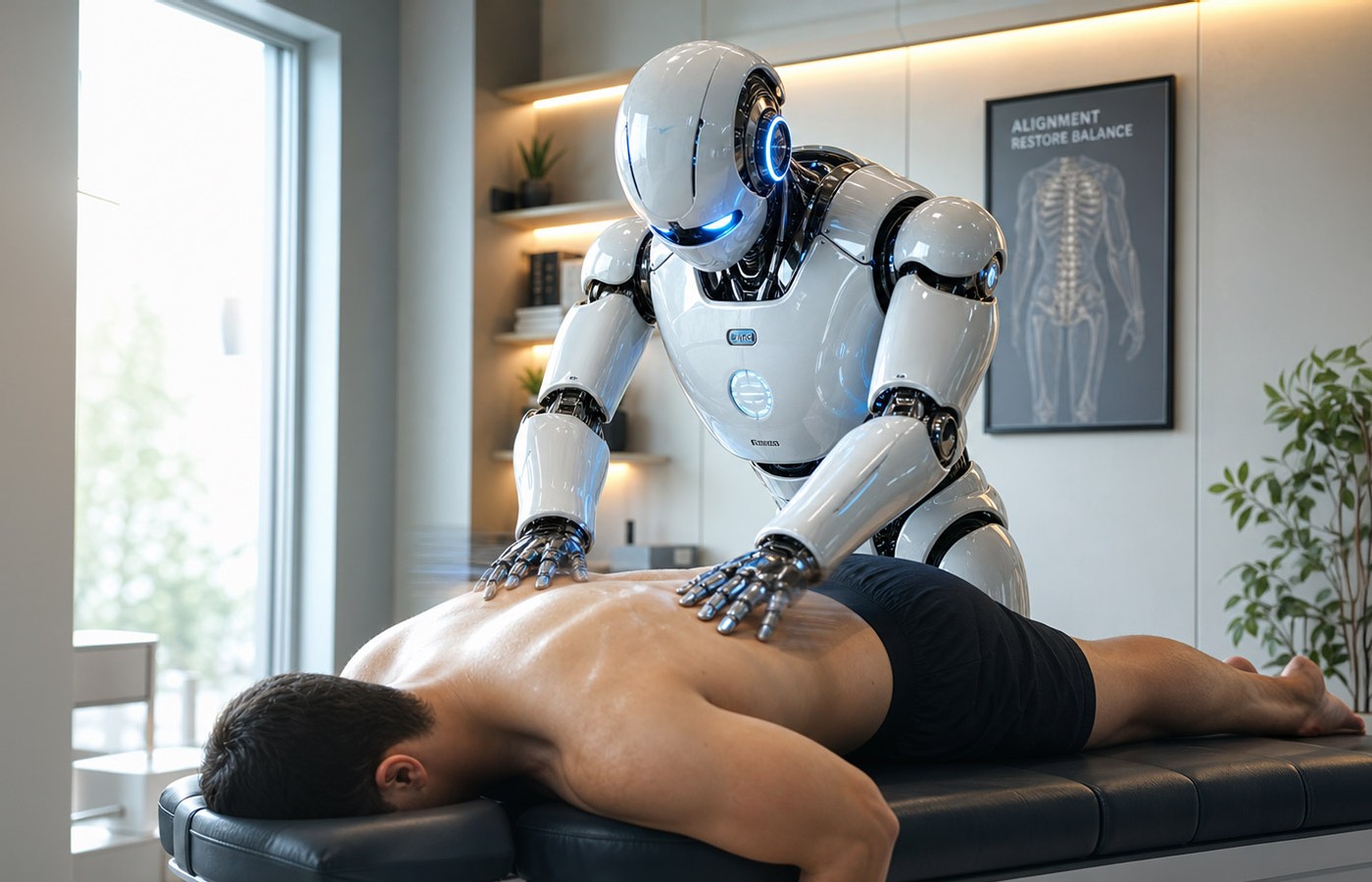
After looking up examples of other highly sophisticated robot activity, I asked myself, Could a robot give a real massage? Then, I couldn’t help but wonder, Could a robot give a real chiropractic adjustment?
We have all seen small foot or back massage cushions, and expensive recliner chairs with multiple massage functions. But could a robot deliver a massage that closely mimics human touch? It turns out, several companies are way ahead in exploring human-like touch research.
Techxplore is an internet site that follows robotics. Several months ago, it reported that researchers in China have developed a robot that mimics “traditional Chinese Medicine” (TCM), meaning specific massage techniques. The patient is positioned prone, with robot arms that “resemble the human hand in shape and size.”1 There are several functions for the arms and “hands,” including a kneading function, palm-punch, vibration, pressing, and beating (petrissage).
The purpose of the robotic development was to provide pain management and functional improvement for older Chinese, considering the decreasing population in that country. Consequently, the development of “helper” robots, such as a house-cleaner, is progressing at a fast pace.
Is the massage robot a feel-good “helper” or a potentially valuable health worker? RealMan Robotics, also based in China, doesn’t seem to care.2 It has the RMC-HC model all ready to go for a cool $30,000. It “generates trajectories based on infrared thermal imaging ... master-level human massage techniques, and [can] be widely used in massage, physical therapy...,” etc. It also uses “autonomous acupoint recognition and adaptive force control,” which sounds a lot more sophisticated than a standard massage device.
DeyeeRobot (Chinese) makes its model specifically for the physical therapy market. It contacts the skin, and once set up by the PT, can do full-body massage, including extremities and feet. It even claims to provide a warm “moxibustion”-type treatment, with artificial intelligence (AI) guidance. The company suggests “the PT’s time with manual therapy can be shortened, or eliminated, allowing for a higher volume of patients treated in a day.”3
Massage therapists in the U.S. have mixed feelings. The American Massage Therapists Association (AMTA) has a balanced response to the robotic scare. It has taken the obvious stance that most people want the human connection and the precise touch recognition that technology may never replicate. But there is the advantage of having a robot do “preparatory” moves that might help shorten the time a manual therapist spends in a 60-90 minute session, and reduce repetitive-use injuries to the therapist.4
The Mayo Clinic is even getting in the act. “Some people call it Chinese massage, but ... it is mostly used for muscle and muscle alignment type issues,” says Dr. Brent Bauer, an internist on staff at the Rochester, Minn., clinic. The clinic is using a unit called TUINA, one of many EMMA robot types. EMMA stands for “expert manipulative massage automation.” Dr. Bauer hopes “it can be a very good treatment for people with chronic low back pain.”5
What about my other question, about chiropractic robot adjustments? A company called Chirobot out of Taiwan6 says its robot uses an “8 axis 3 D AI microcomputer controlled chiropractic robot table.” Yet, the video it shows still looks like a robot massage to me. So far, I have not discovered even one robot that appears it can actually do a “real” diversified or mechanically assisted (e.g. Activator) chiropractic adjustment. But then, I really didn’t expect that I would.
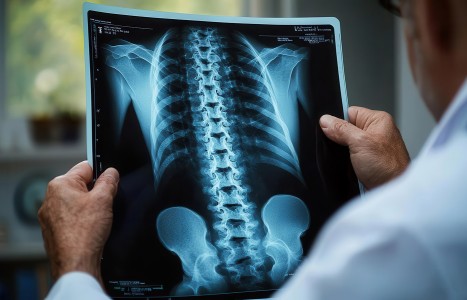
In the history of chiropractic, there have been a few attempts at developing an adjusting machine, different from a hand-held instrument. One of those was the Pettibon adjusting unit, which was discontinued in the late 1980s. The original recumbent table had the instrument with a stylus (a slender hammer) placed at a particular angle, often based on X-ray readings. Then a “rapid volley of percussions” adjustment was made.7
But what isn’t as well-known is the adjusting instrument of Solon Langworthy, DC, one of D.D. Palmer’s very early students. It is hard to describe, but the patented pictures show a device hovering over the prone spine with a stylus ready to “toggle” or recoil upon any vertebra within reach.8
My search for the robot that can give a traditional chiropractic adjustment is on pause. The variables of pressure, infrared, heat, galvanic skin resistance, electromagnetic mapping, percussion, and vibration are indeed already available for chiropractic robots. All that is needed now is the technology that enables the robot to find the “subluxation” and decide how to reduce it, especially with a classic “high-velocity, low-amplitude” adjustment.
Impossible? Well, I used to think that robots could never do backflips.