Blood Zeta Potential, Nutrition and PBM: Practice Implications for DCs
Phil Harrington, DC, CMLSO, FASLMS;
Ana Paula Tanko de Vasconcellos, DDS, MSc
WHAT YOU NEED TO KNOW
Zeta potential refers to the electrical potential at the slipping plane surrounding a suspended particle – in this case, a red blood cell. Clinically, it represents the net negative surface charge on erythrocytes.
Understanding zeta potential provides chiropractors with a practical framework for explaining blood rheology, the impact of diet and metabolic health on circulation, and the emerging role of photobiomodulation (PBM) in improving microvascular function.
While much of the PBM literature focuses on mitochondrial activation and ATP production, an emerging body of evidence demonstrates that PBM also influences blood zeta potential.
Chiropractors have long recognized that optimal healing depends not only on structural alignment, but also on the quality of circulation and microvascular physiology. Oxygen delivery, tissue perfusion and cellular metabolism all rely on proper blood flow characteristics. An important factor influencing blood flow is zeta potential, the electrostatic charge surrounding red blood cells (RBCs).
Understanding zeta potential provides chiropractors with a practical framework for explaining blood rheology, the impact of diet and metabolic health on circulation, and the emerging role of photobiomodulation (PBM) in improving microvascular function.
Zeta Potential Explained
Zeta potential refers to the electrical potential at the slipping plane surrounding a suspended particle – in this case, a red blood cell. Clinically, it represents the net negative surface charge on erythrocytes. Healthy RBC membranes contain negatively charged molecules, primarily sialic acid residues and phospholipids, which cause cells to repel one another in circulation.1,8
This electrostatic repulsion is essential for normal blood flow. When zeta potential is sufficiently negative, RBCs remain separated and move efficiently through the microcirculation. This supports reduced blood viscosity, minimal rouleaux formation, effective capillary perfusion, and optimal oxygen delivery.2
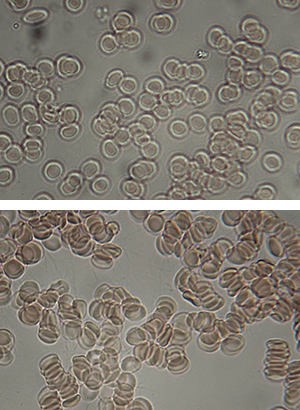
When zeta potential becomes less negative, however, this repulsive force weakens. RBCs begin to aggregate, forming rouleaux: stacked, coin-like structures visible under microscopy. These aggregates increase blood viscosity and impair capillary flow, particularly in tissues with limited perfusion such as peripheral nerves, tendons and joint structures.3,9
Factors Influencing Zeta Potential
A variety of physiological and lifestyle factors can reduce erythrocyte surface charge and promote aggregation. Many of these are commonly encountered in chiropractic patient populations.
One of the most significant contributors is high sugar intake. Postprandial hyperglycemia alters blood chemistry in ways that directly reduce zeta potential.
Elevated glucose increases plasma osmolarity, disrupting the ionic environment surrounding RBC membranes. Chronic hyperglycemia also leads to glycation of membrane proteins, modifying surface molecules responsible for maintaining negative charge.4 In addition, high sugar intake promotes systemic inflammation and increases circulating fibrinogen levels, a key protein that bridges RBCs and accelerates aggregation.5
The combined effect is a functional reduction in zeta potential, resulting in thicker blood and impaired microvascular perfusion. Clinically, this contributes to conditions frequently seen in chiropractic practice, including peripheral neuropathy, chronic inflammation, delayed healing and fatigue. Other factors that negatively influence zeta potential include:
Dehydration, which increases plasma protein concentration
Systemic inflammation, elevating fibrinogen and immunoglobulins6
Oxidative stress, damaging RBC membranes4
Metabolic syndrome and insulin resistance
Together, these factors promote red blood cell aggregation and reduce circulatory efficiency.
Dr. Harrington's blood before dinner (top) and after pasta and two glasses of wine (bottom).
Photobiomodulation: Influence on Blood Zeta Potential
Photobiomodulation (laser therapy) is widely used in chiropractic clinics for pain reduction, tissue repair and inflammation modulation. While much of the PBM literature focuses on mitochondrial activation and ATP production, an emerging body of evidence demonstrates that PBM also influences blood zeta potential.
Experimental studies show that laser irradiation of blood can produce measurable improvements in parameters closely related to zeta potential, including increased erythrocyte electrophoretic mobility, reduced aggregation, improved deformability, decreased viscosity, and enhanced microcirculatory flow.10-13,18
Electrophoretic mobility is particularly important because it reflects the electrical charge of the RBC surface. Increased mobility indicates a more negative surface charge, consistent with improved zeta potential.
These effects were first reported in Eastern European and Soviet-era studies in the 1980s and 1990s, wherein low-intensity laser exposure increased RBC electrophoretic mobility and reduced rouleaux formation in vitro.14-15 Modern PBM research has confirmed these findings, demonstrating improved RBC deformability and aggregation behavior following light exposure.12-13
Mechanisms of Action
Several mechanisms likely explain how PBM influences zeta potential and blood flow. One involves nitric oxide (NO) signaling. PBM can photodissociate nitric oxide from mitochondrial enzymes, enhancing cellular respiration while releasing NO into surrounding tissues. Nitric oxide promotes vasodilation and improves microvascular perfusion, reducing shear forces that contribute to RBC aggregation.17
Another mechanism is the reduction of oxidative stress. Oxidative damage to RBC membranes reduces their negative surface charge. PBM decreases reactive oxygen species and protects membrane lipids, helping preserve normal electrochemical properties.16
PBM may also influence plasma protein interactions. By reducing inflammatory mediators such as TNF-α and IL-6, PBM may lower fibrinogen levels, decreasing the protein bridging forces that promote rouleaux formation.5
Finally, PBM may support the integrity of the vascular glycocalyx, a negatively charged endothelial surface layer that plays a key role in microvascular function and RBC interactions.7
Clinical Implications for DCs
For chiropractors, zeta potential offers a useful physiological lens through which to view patient health. Reduced zeta potential leads to thicker blood, impaired microcirculation, and reduced oxygen delivery, all factors that can slow recovery and limit treatment outcomes. This helps explain why patients with metabolic dysfunction or chronic inflammation often respond more slowly to care.
Photobiomodulation can improve circulatory dynamics. By enhancing RBC deformability, reducing aggregation, and supporting a more favorable electrostatic environment, PBM may help restore efficient blood flow and tissue oxygenation10-13
These effects can complement chiropractic adjustments, rehabilitation strategies and soft-tissue therapies. When combined with nutritional interventions, particularly reducing excessive sugar intake and systemic inflammation, PBM contributes to a more favorable physiological environment for healing.
Blood zeta potential plays a fundamental role in microcirculatory efficiency. When erythrocytes maintain a strong negative surface charge, they repel one another and flow freely through capillaries, supporting optimal tissue oxygenation. Poor dietary habits, metabolic dysfunction, and inflammation reduce this electrostatic repulsion, increasing blood viscosity and impairing circulation.
Emerging evidence suggests that photobiomodulation therapy can improve blood rheology by increasing erythrocyte electrophoretic mobility and reducing aggregation; changes consistent with a healthier, more negative zeta potential.10-13
When seeking to optimize patient outcomes, integrating concepts of nutrition, blood rheology, and PBM therapy provides a powerful, clinically relevant approach to enhancing healing and performance.
References
Eylar EH, Madoff MA, Brody OV, Oncley JL. The contribution of sialic acid to the surface charge of the erythrocyte. J Biol Chem, 1962;237:1992-2000.
Jan KM, Chien S. Role of surface electric charge in red blood cell interactions. J Gen Physiol, 1973;61(5):638-654.
Mohanty JG, Nagababu E, Rifkind JM. Red blood cell oxidative stress impairs oxygen delivery and induces RBC aging. Biophys J, 2014;106(11):2432-2442.
Pretorius E, Bester J, Vermeulen N, et al. Hypercoagulation and fibrin network abnormalities in diabetes. Diabetologia, 2007;50(12):2562-2569.
Vayá A, Suescun M, Todolí J, et al. Inflammation, hypercoagulability and cardiovascular risk in diabetes mellitus. Clin Hemorheol Microcirc, 2015;59(1):5-18.
Lipowsky HH. The endothelial glycocalyx as a barrier to leukocyte adhesion and its relevance to microvascular function. Microvasc Res, 2020;129:103963.
Baskurt OK, Hardeman MR, et al. Handbook of Hemorheology and Hemodynamics. IOS Press, 2007.
Siposan DG, Lukacs A. Effect of low-level laser radiation on some rheological factors in human blood: an in vitro study. J Clin Laser Med Surg, 2001;19(5):257-263.
Mi XQ, Chen JY, Cen Y, et al. A comparative study of 632.8 nm and 532 nm laser irradiation on some rheological factors in human blood in vitro. J Photochem Photobiol B, 2004;74(1):7-12.
Zhu H, et al. Influence of low-level laser irradiation on red blood cell aggregation and deformability. J Photochem Photobiol B, 2019;192:85-90.
Zhu H, et al. Hemorheological alterations of red blood cells induced by photobiomodulation. J Photochem Photobiol B, 2022;231:112409.
Samoilova KA, et al. Effects of low-intensity laser radiation on human blood cells. Biofizika, 1989;34(3):520-522.
Moskvin SV. Low-level laser therapy in Russia: history, science and practice. J Lasers Med Sci, 2017;8(2):56-65.
Barakat BM, et al. Photobiomodulation improves erythrocyte deformability and reduces oxidative stress. Lasers Med Sci, 2016;31(7):1361-1367.
Karu TI. Cellular mechanisms of low-power laser therapy. IEEE J Quantum Electron, 1987;23(10):1703-1717.
Liebert A, et al. A review of intravascular and transcutaneous laser irradiation of blood. Photobiomodul Photomed Laser Surg, 2022;40(2):89-102.
Building on a historic March 2026 meeting between Make America Healthy Again and chiropractic leadership, MAHA has announced the launch of the MAHA Chiropractic Hub, “a coordinated national partnership uniting MAHA Center, MAHA Action, and the chiropractic profession, including national associations, state organizations, practitioners, educators, researchers, and patient advocates. The Chiropractic Hub will advance federal policy, expand patient access, and build broad public support for chiropractic care across America.”
The chiropractic profession is confronting one of the most significant federal regulatory threats it has faced in decades. A new U.S. Department of Education (ED) accountability framework – commonly referred to as the “Do No Harm” (DNH) regulation – could place many chiropractic programs at risk of losing access to federal financial aid (student loans), potentially reshaping the future of chiropractic education and workforce development across the United States.
Pain has become the dominant language of musculoskeletal healthcare. Numeric pain-rating scales and symptom reports are routinely used as primary indicators of clinical success. But while pain reduction is meaningful, it is an incomplete and often misleading representation of recovery. This has real consequences for patient adherence, long-term outcomes, and how conservative care is perceived within the broader healthcare system.