Facing Major Challenge Under Proposed Federal “Do No Harm” Regulation
DIGITAL EXCLUSIVE
WHAT YOU NEED TO KNOW
The “Do No Harm” (DNH) regulation – could place many chiropractic programs at risk of losing access to federal financial aid (student loans), potentially reshaping the future of chiropractic education and workforce development across the U.S.
According to preliminary ED modeling released in early 2026, chiropractic programs appear disproportionately vulnerable under the rule.
In response to the emerging threat, chiropractic organizations are rapidly organizing coordinated advocacy efforts. It is essential that the profession presents a cohesive position to our governmental and regulatory representatives.
Editor’s Note: Article submitted by Dr. Deborah Bushway, vice chair, Association of Chiropractic Colleges (ACC), and president, Northwestern Health Sciences University; and Ms. Anne Marie Munson, ACC executive director.
The chiropractic profession is confronting one of the most significant federal regulatory threats it has faced in decades. A new U.S. Department of Education (ED) accountability framework – commonly referred to as the “Do No Harm” (DNH) regulation – could place many chiropractic programs at risk of losing access to federal financial aid (student loans), potentially reshaping the future of chiropractic education and workforce development across the United States.
At the center of the concern is a new “earnings premium” accountability test passed as part of the 2025 “One Big Beautiful Bill Act” (OBBBA) on July 4, 2025. This earnings premium test applies to all higher education programs (undergraduate and graduate) that receive Title IV funding.
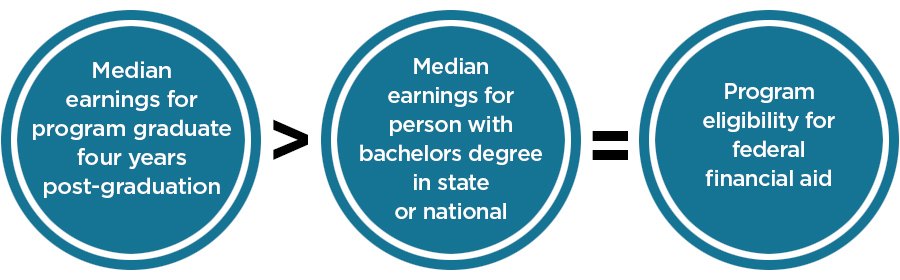
Following a process called negotiated rulemaking, ED released the final regulatory guidelines for DNH on April 20th, 2026, initiating a 30-day comment period (comment here). This regulation ties each academic program’s continued eligibility for Title IV student loans directly to median graduate earnings four years post-graduation.
If graduates’ IRS-reported earnings from a program do not exceed a federally determined earnings benchmark two times within a three-year period, that program becomes ineligible for all federal student loans beginning as early as July 2028. For all graduate programs, including chiropractic, the federally determined earnings benchmark is the median earnings for people aged 25-34 with an undergraduate degree in a related field.
It is important to note that this earnings premium test has nothing to do with the cost of tuition or the quality of the education. Past gainful employment tests from ED did rely on tuition as one key input (the debt-to-earnings ratio) or on loan repayment (cohort default rates). However, in this new test, tuition, graduation rates, board pass rates, loan default rates or other quality metrics play no role.
For chiropractic colleges, the implications are profound.
Preliminary Data Raise Concerns
According to preliminary ED modeling released in early 2026, chiropractic programs appear disproportionately vulnerable under the rule. Initial draft data identified 13 chiropractic programs in the federal data set, and among those with complete information, approximately 62% would fail the proposed earnings test and potentially lose access to federal student loan eligibility.
For programs with missing data, there is a complex process to aggregate graduate information until it becomes “statistically reliable” (a term that ED explicitly states that is has deliberately not specified).
Although ED has emphasized that the current data sets are preliminary and subject to revision, we remain concerned that the regulatory framework itself fundamentally misunderstands the economic realities of chiropractic practice.
Unlike many salaried professions, the majority (Source: 25 NBCE Practice Analysis 2025, p. 25) of chiropractors operate through entrepreneurial, small-business, and self-employed practice models. Many new graduates spend their early professional years building patient bases, opening practices, managing overhead expenses, and investing in long-term business growth. These realities often suppress taxable income during the first several years after graduation, even when practitioners are successfully establishing viable and sustainable careers.
Critics argue that the proposed DNH regulation fails to account for these distinctive professional pathways.
A One-Size-Fits-All Metric
One of the profession’s central concerns is that the proposed federal methodology applies a one-size-fits-all earnings formula across vastly different academic and professional fields.
As mentioned above, the DNH proposal focuses almost exclusively on short-term postgraduate earnings data, without considering broader measures of professional success, healthcare access, patient outcomes, or long-term career development.
One critical question relates to how earnings are measured. It is unclear which sections or lines of IRS tax filings are being evaluated, and whether the self-employment income reported to the IRS accurately reflects actual economic stability or wealth creation, for both the chiropractors and their communities. For chiropractors who operate independent practices, taxable income may not capture the value of business ownership, equity development, community employment generation, or future earnings potential.
There is also concern that the model penalizes a profession which offers career flexibility by including the data from graduates pursuing part-time practice models, integrative health collaborations, rural practice development, or delayed careers.
In short, the ACC and others argue the regulation measures only a narrow snapshot of early-career income rather than the full professional and economic impact of a chiropractic career.
Impact on Students and Patient Access
Currently, the DNH regulation could dramatically reduce access to chiropractic education.
Loss of Title IV eligibility would eliminate access to federal student loans for affected programs. Chiropractic colleges warn that the regulation could reduce enrollment, limit socioeconomic diversity within the profession, and ultimately shrink the future chiropractic workforce at a time when demand for conservative, nonpharmacologic healthcare continues to grow.
This concern is particularly significant in rural and underserved communities, where access to nonsurgical musculoskeletal care remains limited. Chiropractic advocates argue that reducing the pipeline of future chiropractors would directly undermine broader national healthcare priorities focused on pain management alternatives, whole-person care, and reducing dependence on opioids.
Supporters of the profession also point to growing evidence demonstrating the value of chiropractic care in improving patient outcomes and reducing healthcare costs. Yet critics of the DNH proposal note that none of these measures is considered within the current accountability framework.
The regulation evaluates only earnings – not healthcare value, patient outcomes, workforce shortages, or public health benefit.
Building a Unified Response
In response to the emerging threat, chiropractic organizations are rapidly organizing coordinated advocacy efforts. It is essential that the profession presents a cohesive position to our governmental and regulatory representatives.
The ACC is actively and urgently engaging to create potential solutions. The ACC has mapped out a three-part response to the threat:
Engage in the public comment period. The ACC has engaged an experienced and well-respected law firm, Cooley, LLP, to craft meaningful and relevant comments for submission by ACC. These comments will be shared with ACC members, and ACC encourages colleges, practitioners, students, and national organizations to tailor their comments while maintaining a consistent message and actively participate in the federal public comment process. Comments are due by May 20, and must be submitted via the link provided by ED: https://www.regulations.gov/docket/ED-2026-OPE-0100/comments.
Prepare for potential legal action. While ED is legally required to consider all comments, it appears possible that the comments will have little impact on the final regulation. This is not meant to discourage comment participation, because fully participating in the effort to “exhaust administrative remedies” is essential to this second step. We anticipate release of the final rule in July. More to come on this phase in the future. During this phase, there may be opportunities and need for larger community advocacy and engagement.
Create private lender pathways.
Chiropractic organizations are also collaborating with acupuncture, naturopathic medicine, occupational therapy, and other healthcare professions that may also be negatively impacted by the proposed rules. Shared concerns include flawed earnings methodologies, inadequate recognition of professional licensure standards, and failure to account for independent practice models common throughout healthcare.
A Defining Moment for Chiropractic Education
Many within the profession view the DNH proposal as a defining moment for the future of chiropractic education and professional recognition.
While few oppose reasonable accountability standards in higher education, we would argue that any federal framework must fairly account for differences in professional structure, workforce contribution, and long-term career trajectories. Applying earnings formulas without context risks disproportionately harming healthcare professions that rely on entrepreneurship, patient-centered care, and independent practice development.
The profession now faces a critical challenge: ensuring that federal policymakers understand that chiropractic education cannot be accurately evaluated using simplistic short-term earnings metrics alone.
For chiropractic colleges, students, practitioners, and the patients they serve, the stakes could not be higher.
While cervical disc pathology can unquestionably produce radiculopathy, many patients presenting with arm pain, paresthesia or perceived weakness do not exhibit the clinical behavior of true nerve-root compromise. In these cases, failure to differentiate the primary pain generator may lead to unnecessary spinal injections, nerve ablation procedures or surgical consultation despite limited likelihood of benefit.
The New Jersey Board of Chiropractic Examiners has made a precedential decision, concurring with the Association of New Jersey Chiropractors' (ANJC) position paper on chiropractic X-ray guidelines. In plain terms, the board ruled, consistent with the ANJC position, that insurance companies cannot use medical X-ray rules or recommendations, like those written by the American College of Radiology (ACR), to decide whether a chiropractor's X-ray was necessary.
For decades, chiropractors have been told the answer to more professional referrals is simple: educate medical doctors about chiropractic. There is some truth in that advice; but it is also incomplete. The modern challenge is not simply getting another healthcare professional to know that chiropractors exist. It is becoming the kind of clinician (and building the kind of professional relationship) that makes collaboration easy and sustainable.