Excessive pronation is almost always blamed for the development of functional hallux limitus.
However, a frequently overlooked cause of this condition occurs when the flexor hallucis longus tendon gets trapped in the retrotalar pulley located behind the medial malleolus.
The combination of gentle joint mobilizations and prolonged static stretching effectively improves first MTP function in people with limited FHL gliding.
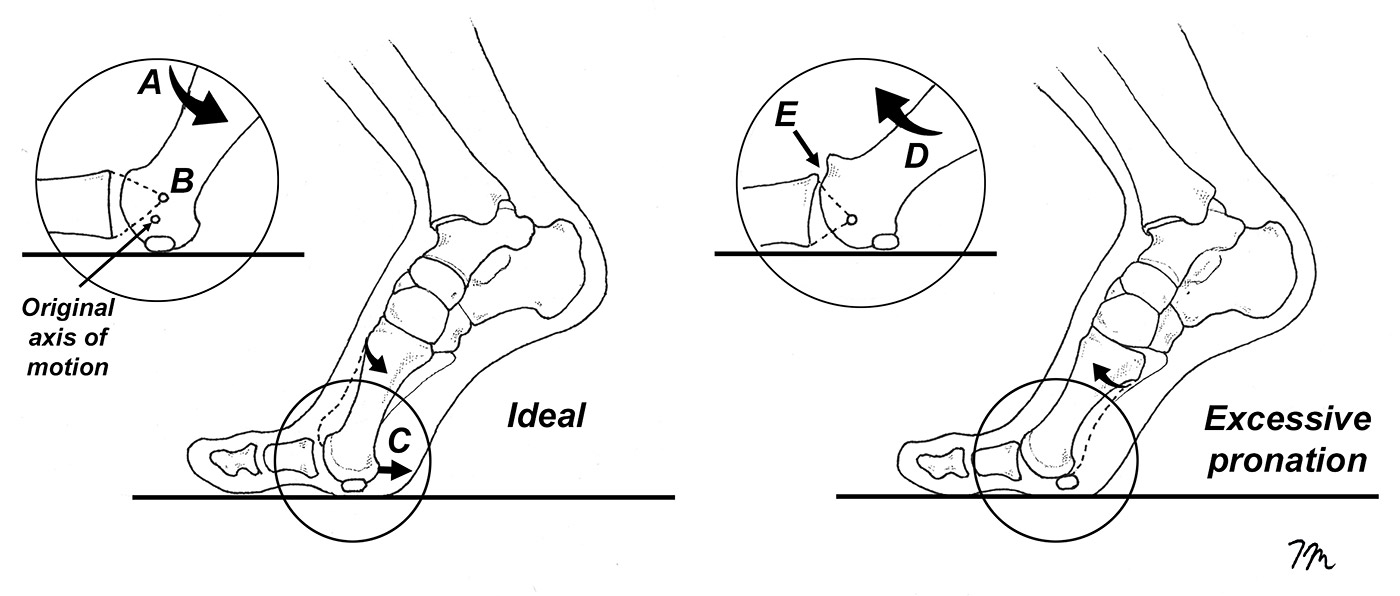
Functional hallux limitus occurs when excessive pronation shifts the talus medially, increasing pressure under the medial forefoot. This pressure lifts the first metatarsal head above the second, triggering a bony locking mechanism that restricts first metatarsophalangeal (MTP) joint movement. (Fig. 1) This locking mechanism is a common cause of pain in the first MTP as the proximal phalanx jams against the upper portion of the first metatarsal head, creating a characteristic dorsal spur on the first metatarsal head
FIG 1 Mechanism of functional hallux limitus. In order for the first MTP to dorsiflex through a full range of motion during propulsion, the first metatarsal must actively plantarflex (A), which allows for a dorsal-posterior shift ing of the transverse axis of the first MTP (B) as the metatarsal head glides posteriorly over the sesamoids (C). This new axis allows for an unrestrained range of hallux dorsiflexion, which improves congruency between the first metatarsal head and its proximal phalanx. When excessive foot pronation is present, medial displacement of ground reactive forces maintain the first metatarsal in an elevated position (D), thereby preventing the normal dorsal-posterior shift of the transverse axis necessary to achieve full dorsiflexion. The hallux is now forced to dorsiflex about the original axis, decreasing parallelism of the articular surfaces and resulting in jamming of the dorsal cartilage (E).
People with hallux abductovalgus are even more prone to pain with functional hallux limitus, as the increased dorsal compressive force causes the first metatarsal to adduct, which significantly increases the intensity of bunion pain.
Causation / Complications
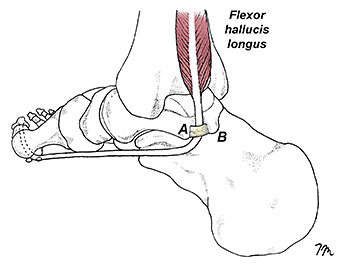
FIG 2 Entrapment of the flexor hallucis longus tendon in the retrotalar pulley. The tendon of flexor hallucis longus passes through a small tunnel located between the posteromedial (A) and posterolateral (B) processes of the talus. Adhesions of the tendon and its synovial lining at the pulley can restrict gliding of the flexor hallucis longus tendon through the pulley, an effect likened to a cork becoming lodged in a bottle.4
While excessive pronation is almost always blamed for the development of functional hallux limitus, a frequently overlooked cause of this condition occurs when the flexor hallucis longus tendon gets trapped in the retrotalar pulley located behind the medial malleolus.1 (Fig. 2) This condition is particularly common in classical ballet dancers, gymnasts, figure skaters, and soccer players.
When present, restricted movement of the FHL tendon impairs dorsiflexion at the first MTP joint, which in turn prevents shifting of the first MTP’s transverse axis, causing the proximal phalanx to jam into the dorsal aspect of the first metatarsal head. Over time, the increased pressure can lead to a worsening of hallux limitus and/or hallux abductovalgus and may eventually lead to hallux rigidus.
According to Vallotton, et al.,2 functional hallux limitus is a frequently misdiagnosed clinical entity and its destructive effect on the first MTP has been underestimated. The authors claim that limited excursion of the FHL tendon is the most common cause of functional hallux limitus.
Diagnosis: The FHL Stretch Test
Fortunately, limited excursion of the FHL tendon is easily diagnosed by performing the FHL stretch test.3 This test is performed by measuring first MTP dorsiflexion with the ankle plantarflexed slightly, and then again with the ankle fully dorsiflexed. The test is positive when first MTP dorsiflexion is significantly limited when measured with the ankle fully dorsiflexed.
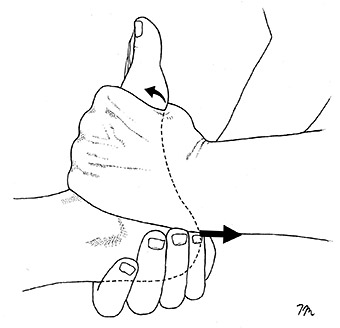
FIG 3 The Hoover cord maneuver. With the pati ent resting supine, both hands work together to simultaneously traction the subtalar joint while maintaining the ankle in a slightly dorsiflexed position (arrows). While maintaining constant traction, the hand contacting the heel gently sways the subtalar joint through a full range of inversion/eversion. These movements encourage distal glide of the tendon through the pulley, thereby increasing the length of the FHL tendon between the pulley and its insertion on the distal phalanx.2
Correction Techniques
Researchers from Switzerland note that it is possible to correct limited excursion of the FHL tendon with a simple manual technique known as the Hoover cord maneuver.2 This maneuver is performed by grasping the heel with one hand while simultaneously dorsiflexing the forefoot with the other. (Fig. 3) The hand grasping the heel creates a firm distraction force while gently rocking the calcaneus from full inversion to full eversion.
According to the authors, this maneuver almost always allows for the full restoration of first MTP dorsiflexion, which is immediately apparent to the patient, “who is often surprised to see the recovery of the great toe’s range of motion after the manipulation.” The authors performed this mobilization on 16 participants and noted immediate increases in first MTP motion in every subject.
To avoid ongoing entrapment of the FHL tendon in the retrotalar pulley, daily bent-knee calf stretches should be done with a towel placed beneath the big toe. This stretch improves gliding of the FHL tendon, and should be held for a minimum of 45 seconds and repeated at least five times each day.
The combination of gentle joint mobilizations and prolonged static stretching effectively improves first MTP function in people with limited FHL gliding. While some authors recommend open surgical release of the retrotalar pulley to manage this condition, Vallotton, et al.,2 suggest the potential risks outweigh the benefits and recommend difficult cases be treated with endoscopic release of the FHL muscle, which is less invasive, has a faster recovery time, and may prevent gradual degeneration of the first MTP joint.
Based on my experience, surgical intervention is seldom required, as conservative measures, including the use of orthotics when excessive pronation is present, typically yield excellent outcomes.
References
Sockalingam N, Reymond N, Rybnikov A, et al. Do patients with functional hallux limitus have a low-lying or bulky FHL muscle belly? Foot & Ankle Orthopaedics, 2023 Feb;8(1):24730114231153140.
Vallotton J, Echeverri S, Dobbelaere-Nicolas V. Functional hallux limitus or rigidus caused by a tenodesis effect at the retrotalar pulley: description of the functional stretch test and the simple Hoover cord maneuver that releases this tenodesis. J Am Podiatric Med Assoc, 2010 May 1;100(3):220-9.
Michelson J, Dunn L. Tenosynovitis of the flexor hallucis longus: a clinical study of the spectrum of presentation and treatment. Foot & Ankle Int, 2005 Apr;26(4):291-303.
Hamilton W. Stenosing tenosynovitis of the flexor hallucis longus tendon and posterior impingement upon the os trigonum in ballet dancers. Foot & Ankle, 1982 Sep;3(2):74-80.
While cervical disc pathology can unquestionably produce radiculopathy, many patients presenting with arm pain, paresthesia or perceived weakness do not exhibit the clinical behavior of true nerve-root compromise. In these cases, failure to differentiate the primary pain generator may lead to unnecessary spinal injections, nerve ablation procedures or surgical consultation despite limited likelihood of benefit.
The New Jersey Board of Chiropractic Examiners has made a precedential decision, concurring with the Association of New Jersey Chiropractors' (ANJC) position paper on chiropractic X-ray guidelines. In plain terms, the board ruled, consistent with the ANJC position, that insurance companies cannot use medical X-ray rules or recommendations, like those written by the American College of Radiology (ACR), to decide whether a chiropractor's X-ray was necessary.
For decades, chiropractors have been told the answer to more professional referrals is simple: educate medical doctors about chiropractic. There is some truth in that advice; but it is also incomplete. The modern challenge is not simply getting another healthcare professional to know that chiropractors exist. It is becoming the kind of clinician (and building the kind of professional relationship) that makes collaboration easy and sustainable.