Editor's Note: As introduced in part 1 [March digital issue], post-traumatic stress disorder (PTSD) can develop following an MVA when the patient had been earlier diagnosed with mTBI, acute stress disorder (ASD) or post-concussion syndrome (PCS). In this article, clinical criteria leading to the diagnosis of mTBI are reviewed that may give insight into the evolving PTSD.
A significant public health concern is traumatic brain injury that affects over 1.5 million annually in the U.S., particularly children and young adults. Traumatic brain injury also has a significant worldwide impact and is a leading cause of mortality and disability. Motor-vehicle accidents are a primary cause of mTBI. However severe, these injuries may present to non-ED treatment facilities that see acutely injured MVA patients due to delayed symptom development.1-3
Diagnostic Considerations
Traumatic brain Injury (mTBI) is graded as mild, moderate or severe. The rating is based on the Glasgow Coma Scale (GCS).2 Scores of 13 to 15 are graded as mild and represent the majority of mTBI patients. Patients with GCS scores of 9-12 are considered to be moderate. A patient with a score of 15 and a loss of consciousness (LOC), amnesia of any duration, vomiting or diffuse headache should also be graded as having a moderate mTBI. Severe mTBI is indicated with GCS scores of eight or less.2,4
The Glasgow Coma Scale should be provided to any patient suspected of a head injury. A CT examination of the head should be ordered in any case with a GCC score is less than 15.1,4 A GCC is available to download here.
Traumatic brain injury can develop following blunt-force trauma to the head. Physical examination may demonstrate obvious signs of internal cranial bleeding associated with severe head trauma. Periorbital ecchymosis (raccoon eyes/ panda sign) may not be visible until 1-3 days post-accident as blood pools around the orbits. This sign represents a skull base fracture 50-60% of the time.5-6
Severe head trauma is also identified by mastoid ecchymosis (Battle sign) and cerebrospinal fluid leakage (CSF) from the nose and/or ears. The finding, which may take one to two days to develop, represents a 100% predictive likelihood of basilar skull fracture. Follow-up CT or contrast MRI evaluation is suggested.6-7 Cerebral herniation and post-traumatic intraparenchymal hemorrhage (tICH) are catastrophic results of severe TBIs.6-7
Traumatic brain injury (mTBI) more often occurs when there is sudden movement of the brain within the cranium as a result of non-penetrating blunt-force trauma to the skull due to a shear force affecting the head and neck.1,4,6 Detachment of the protective meninges can result in epidural hematoma (EDH) when blood forms between the skull and dura mater.
Subarachnoid hemorrhage (SDH) occurs when ruptured venous blood pools between the dura and arachnoid mater. This may take several days to even weeks to develop. Pupil fixation, diminishing patient alertness, ataxia, confusion, and a declining GCS in excess of two points upon weekly retest in the suspected head-injury patient suggests an immediate CT/MRI follow-up. Any intracranial hemorrhage requires immediate medical attention.1,4,6-7
Diffuse axonal injury (DAI) is another severe mTBI. Diffuse axonal injury occurs when shearing of axons due to linear or rotational accelerating-decelerating forces occurs as a result of the MVA. The linear or rotational acceleration deceleration movements of the head place strain upon the white-matter tracts. The rapid motion tears axons and small vessels at the gray-white interface and within the corpus callosum and possibly the brainstem in severe cases.
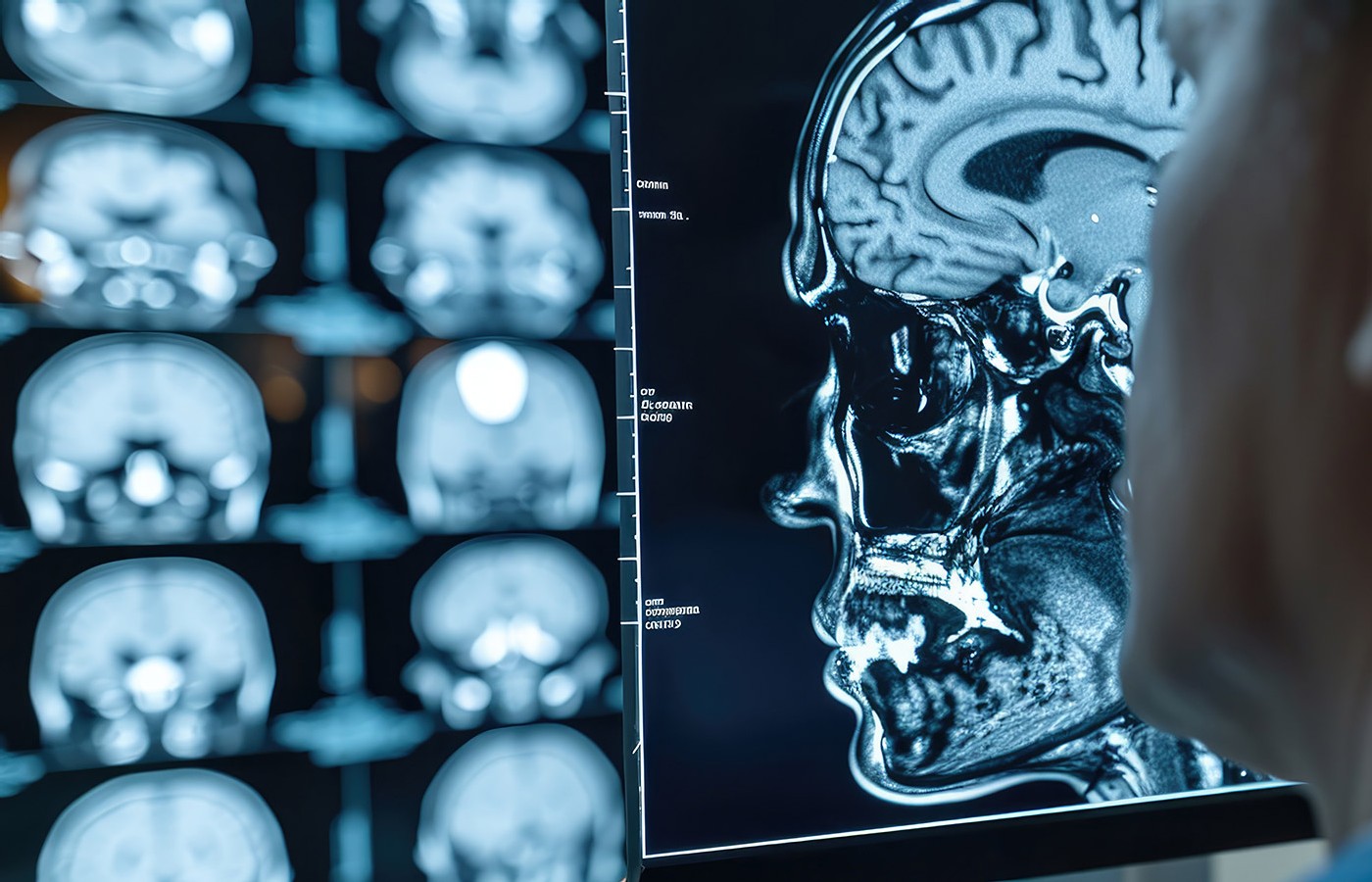
Angular acceleration as a result of high-speed deceleration is the primary force. The motion occurs so quickly that the axonal tolerance is exceeded, resulting in the axonal injury. One of the most common pathological objective findings of mTBI is DAI. White-matter hyperintensities (WMH) are identified by punctate intraparenchymal hemorrhages on CT and MRI.1-2
Diffuse axonal injury can be identified on early CT evaluation; however, MRI scan is the most reliable source for identifying WMH. The observation of DAI on initial CT scanning or follow-up MRI scanning represents a severe mTBI.3
Diffuse axonal injury is almost always found in patients who have had a loss of consciousness (LOC).1 Clinically, DAI is suspected when the patient describes autonomic hyperactivity. This can include excessive sympathetic discharge signs such as hyperhidrosis/polyhidrosis, a sudden blood pressure spike, syncope, and hypo or hyperthermia.8-9
DAI is also discovered when the concussion patient complains of severe headache and vertigo.10 Severe headache following consumption of minimal levels of alcohol also likely indicates the presence of DAI.11
MVA Cranial Nerve Examination Pearls
During the initial clinical examination following an MVA, it is important to perform a cranial nerve examination to detect subtle signs of head injury, brainstem injury and skull fracture. In performing the cranial nerve examination, MRI detection of DAI is found when the following is identified:
- CN 1: Indicates olfactory disorders to include anosmia, hyposmia, hyperosmia, phantosmia/parosmia, dysosmia, and cacosmia.15-19
- CN 2: Intense or new photophobia is reported.12 Pupil asymmetry is observed.13
- CN 3,4 and 6: May demonstrate delayed pursuit or nystagmus when testing.13 The PERRLA evaluation may demonstrate epiphora due to pupil illumination. This may be a delayed reaction to one or both eyes of up to five seconds upon testing.14
- CN 7: Ageusia, dysgeusia, parageusia, and dysgeusia. Verbally inquiring if commonly eaten foods taste different or are “off.”15,17-19
- CN 8: Testing auditory function may note hyperacusis or hypoacusia, tinnitus and nystagmus. Romberg's test may be positive, demonstrating unsteadiness or even falling.15-19
- CN 12: Results in a failure of the patient to place tongue-in-cheek; likely to note DAI on MRI follow up.12
Any additional CN impairment or dysfunction noted upon examination merits a brain MRI to rule out brain-stem injury as a result of the MVA. Note that two-thirds of neural connections to the brain are tied to vision.20
Implementation of these imaging indicators has successfully increased in-office objective evidence of DAI to 27%; substantially more than the LOC cases alone. All brain MRI scans were imaged within the first four weeks following the MVA date of injury.
mTBI and PTSD: Connecting the Dots
An mTBI from blunt-force head trauma or DAI detected at the medial prefrontal cortex or hypothalamus-pituitary-adrenal axis (HPA axis) provides radiographic evidence of PTSD when evaluated with MRI. The medial prefrontal cortex is involved in cognitive functions and is primarily utilized in decision-making and planning, impulse control, working memory, and emotional regulation.
The HPA axis normally enables a quick, short-term response to immediate threats preparing the body for “fight or flight.” Impaired fear extinction, poor cognitive control over trauma -related memories, hypervigilance and poor emotional regulation can occur. Dysregulation is a common neural identifier of PTSD.2,21
A patient diagnosed with a mild mTBI is twice as likely to develop PTSD as one who did not have a mTBI following involvement in a traumatic injury. The likelihood of developing PTSD increases as the severity of mTBI increases.22
Due to the litigious nature of motor-vehicle accident cases, it’s important to note that white-matter hyperintensity (WMH) changes can occur from other etiologies other than head injury from the MVA. Elderly patients or patients that have a stroke history may develop arteriosclerotic small-vessel disease and demonstrate WMH on MRI. Patients with a diabetic history may also develop WMH changes observable on MRI. A thorough review of the patient’s past medical history during the initial intake will alert the provider to these comorbidities. This information will be useful when evaluating advanced imaging to evaluate for DAI.20,23-24
References
- Dave S, Tichauer, M. “Seven Potentially Devastating Traumatic Brain Injuries.” Medscape, Sept. 5, 2025.
- Mesfin F, Gupta N, Shapshak A, Margetis K. “Diffuse Accidental Injury.” StatPearls Publishing, January 2025.
- Oleshko, A, Gruenbaum B, Zvenigoodsky, V, et al. The role of isolated diffuse axial brain injury on posttraumatic depressive and anxiety -like behavior in rats. Transl Psychiatry J, March 31, 2025;15:113.
- Evans R. Neurology and Trauma. New York, New York: Oxford University Press, 2006: pp. 96-98.
- Das J. Munakomi S. “Raccoon Sign.” StatPearls Publishing, January 2025.
- Cimino-Fiallos N. “Hard Hits: Blunt Force Trauma.” Medscape, March 18, 2025.
- Becker A. Metheny H, Trotter B. “Battle Sign.” StatPearls Publishing, June 26, 2023.
- Low P. Clinical Autonomic Disorders. Philadelphia, PA: Lippincott-Raven Publishers, 1997: p. 421.
- Low P, Op Cit, pp. 238-239.
- Low P, Op Cit, p. 724.
- Jagoda AS, et al. Clinical policy: neuroimaging and decision-making in adult mild traumatic brain injury in the acute setting. Ann Emerg Med, 2008 Dec;52(6):714-48.
- Evans R, Op Cit, pp. 97-103.
- Evans R, Op Cit, p. 208.
- Kulkarni AR, et al. Ocular manifestations of head injury: a clinical study. Eye, 2005;19:1257-1263.
- Dalby BJ. Chiropractic diagnosis and treatment of closed head trauma. J Manipulative Physiol Ther, 1993 Jul-Aug;16(6):392-400.
- Foreman S, Croft C. Whiplash Injuries: The Cervical Acceleration/Deceleration Syndrome, 3rd Edition. Philadelphia: Lippincott Williams & Wilkins, 2002: p 160.
- “Traumatic Brain Injury: Possible Effects of TBI.” Synapse: Australia’s Brain Injury Organisation.
- Concussion. The Mayo Clinic.
- Guidelines for Mild Traumatic Brain Injury and Persistent Symptoms. Ontario Neurotrauma Foundation.
- Wang D-Q, Wang L, et al. Relationship between type 2 diabetes and white matter hyperintensity: a systematic review. Front Endocrinol, 2020 Dec 21:11:595962.
- Larsen S, Vasterling J. “Traumatic Brain Injury and PTSD.” PTSD: National Center for PTSD.
- Vasterling J, Jacob S, Rasmussen A. Traumatic brain injury and posttraumatic stress disorder: conceptual, diagnostic, and therapeutic considerations in the context of co-occurrence. J Neuropsychiatry Clin Neurosci, 2018 Spring;30(2):91-100.
- Xiong Y, Mok V. Age-related white matter changes. J Aging Res, 2011;2011:617927.
- Post-Traumatic Stress Disorder, University of Maryland Medical Center.