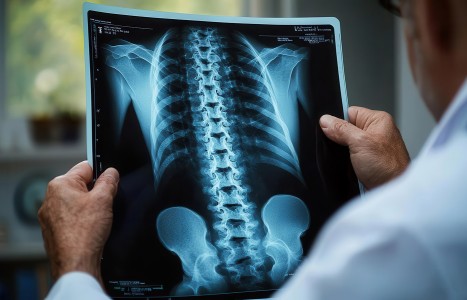
A new patient presented to our clinic stating that he has suffered severe neck and back pain for over seven years that began after a car accident. The pain level following the accident was 8/10. He first visited his GP, who ordered X-rays and initiated a course of NSAIDs, acetaminophen, rest, and ice packs. After a month with little improvement (pain 7/10), the doctor prescribed muscle relaxants for two months, but these did little to reduce the pain or improve function.
The GP then decided to send the patient to a pain clinic, where they performed an MRI. They proceeded to give the patient opioids and monthly steroid injections (two in the cervical spine and three in the lumbar spine at each visit). After 14 months, the pain was slightly reduced (4-6/10) with the opioids. On the day of injections and a day later, the pain was worse.
The patient sought alternatives to the opioids and injections. Over a six-year period, the patient tried acupuncture, laser, shockwave, chiropractic, and spinal rehab (pain-contingent). All gave short-term pain relief (3-5/10), but the severe pain always returned in a few months. Today, the patient continues to take opioids.
Exam Findings
This is a 29-year-old male. Functional Rating Index score was 63%. On examination, he was friendly and cooperative. The dynamometer of the right hand was 45 pounds and the left hand was 40 pounds; the patient is right-handed. Foraminal compression and shoulder depressor were positive bilaterally.
The pain restricted cervical range of motion to 45% in all motions. There was 50% restriction to lumbar range of motion with pain at flexion, extension, right lateral flexion, and left lateral flexion of the lumbar spine.
The splenius capitis, sternocleidomastoid, upper trapezius, rhomboids, erector spinae, and quadratus lumborum muscles all had 8/10 levels of spasm and pain.
Kemp sign, straight-leg raising, passive lumbar extension test, and Ely’s were positive. Neurological reflexes and vital signs were within normal limits.
Medical Records
All urine and blood tests were within normal limits. The X-rays found no new fractures or dislocations; there was a reversal of the normal cervical curve, an old compression fracture with degeneration at C5 and C6, and advanced degeneration at L4 and L5. MRI found no serious pathology. Spinal degeneration was noted in the cervical and lumbar spine.
Discussion / Treatment Plan
Imaging results are not relevant to this patient’s chronic pain. Research has consistently found no relationship between spinal degenerative changes and spinal pain and/or dysfunction.1,5
This patient had been treated by a competent chiropractor. Given the lack of long-term benefits from all previous therapies, we decided against providing more of the same. We decided that this patient would be a good candidate for neuroscience pain education.
Neuroscience pain education modifies how people experience pain by reconceptualizing and reducing the nervous system’s hypersensitivity. Numerous clinical trials strongly support its benefits.4,6 The program we used is specifically designed for patients dealing with chronic spinal pain.2
This program includes educating and discussing the neuroscience pain education materials, followed by non-pain-contingent rehabilitation and neuroscience pain education coaching visits.
Follow-Up
At the completion of the program, the patient’s spinal pain score was 4/10, and opioid use was reduced by 60%. At the one-month follow-up, the spinal pain was 3/10 with no opioids. At the three-, six- and 12-month follow-ups, the patient was stable for pain (3/10) and function (Functional Rating Index score < 10%). He is working full-time and not taking any pain medications.
Comment
Most of the time, a conservative package that includes acupuncture, laser, shockwave, chiropractic, and spinal rehab will provide long-lasting pain relief and a return to normal function. However, this is not always the case.
There is a critical need for care options in this patient population, and we need to extend our skill set so we can serve this need. In 2023, CDC’s National Center for Health Statistics reported that over 63 million U.S. adults suffer with chronic pain lasting three months or longer.3 Moreover, over 22 million adults have high-impact chronic pain that is severe enough to restrict daily activities.
By expanding our expertise to include neuroscience pain education, we have the opportunity to bridge the gap for these patients by offering them a path to relief when all else has fallen short. With millions suffering from chronic pain that disrupts their daily lives, it is our responsibility to evolve, adapt, and provide the hope these patients deserve.
References
- Brinjikji W, Luetmer PH, Comstock B, et al. Systematic literature review of imaging features of spinal degeneration in asymptomatic populations. Am J Neuroradiol, 2015;36:811-6.
- Feise RJ. Pain neuroscience education and non-pain-contingent rehab program. Institute of Evidence-Based Chiropractic, Scottsdale, Ariz., 2018.
- Lucas JW, Sohi I. Chronic pain and high-impact chronic pain in U.S. adults, 2023. NCHS Data Brief No. 518. National Center for Health Statistics, 2024.
- Malfliet A, Kregel J, Coppieters I, et al. Effect of pain neuroscience education combined with cognition-targeted motor control training on chronic spinal pain: a randomized clinical trial. JAMA Neurol, 2018;75:808-817.
- Steffens D, Hancock MJ, Maher CG, et al. Does magnetic resonance imaging predict future low back pain? A systematic review. Eur J Pain, 2014;18:755-65.
- Tegner H, Frederiksen P, Esbensen BA, Juhl C. Neurophysiological pain education for patients with chronic low back pain: a systematic review and meta-analysis. Clin J Pain, 2018;34:778-786.