Kevin M. Wong, DC
Editor's Note: The following is the first of three case studies by Dr. Wong on conservative management of lower-extremity complaints.
History & Subjective Complaints
Patient reports with pain in the front part of her right knee, especially during and after her weekly Zumba class. She states there has been no injury of which she is aware. No outward sign of injury is observed.
Objective Findings & Vitals
Patient is an African-American female, 42 years old. Height: 5'8." Weight: 140 lbs.
Objective Orthopedic and Neurological Findings
Patient is a non-smoker and non-drinker, and her blood pressure and pulse rate fall within normal range. BMI is healthy. She shows moderate calcaneal eversion with hyperpronation on the right and mild bilateral knee valgus. There is a limitation in lumbosacral motion with tenderness and loss of mobility to the right; compensating subluxation is noted.
Range-of-motion tests in knees demonstrate ROM to be full and bilaterally pain-free. Muscle testing shows no abnormal weakness. Neurologic testing is negative.
Radiology
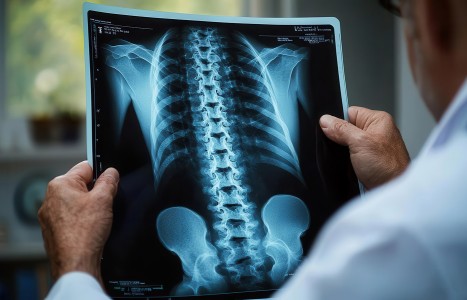
No abnormalities detected.
Clinical Impressions and Working Diagnosis
Elevated Q-angle foot pronation leading to patellofemoral arthralgia on the right. This is accompanied by lumbosacral joint motion restriction and compensatory lower thoracic subluxation.
Treatment
- Adjustments to lumbosacral joint and lower thoracic region.
- Scanning and prescribing flexible custom orthotics to decrease the Q-angles and support the three arches. Pairs were ordered for business as well as athletic shoes.
- More supportive footwear was recommended in addition to the orthotics.
- Rehabilitative exercises including at-home rehab program for remodeling and strengthening afflicted areas.
Response to Care and Discussion
The patient responded well to adjustments and reported a significant decrease in symptoms. Within two weeks of beginning to wear orthotics, she reported further decrease in pain and limitation. She recently completed a weekend-long Zumba "camp," throughout which she remained pain free.