Low back pain is the leading cause of disability worldwide and the hybrid worker is at risk, like everyone else. Hybrid workers are looking for solutions that are accessible and effective, and the solutions span from ergonomics to increasing proprioception and intrinsic core stability.
Before discussing the variable-height desk (which presents issues of its own), the demands of sitting need to be addressed. We have known for decades that 30 degrees of lumbar flexion puts the greatest load on the lumbar discs, and sitting in slight lumbar flexion has a significant negative impact on the lumbar spine. Therefore, the first step is to maintain neutral spine while sitting throughout the day, not just for a five-minute stretch break.
Sitting posture actually starts with the appropriate chair. A chair must have a variable seat height with armrests that are retractable to avoid hitting the desk. If armrests hit the desk the worker must lean forward to get to their work, creating lumbar flexion. Plus, the worker needs to have their back against the back of the chair. This requires the seat pan to be the correct depth. If the seat pan is too deep, the worker must once again lean forward to get to their work.
Finally, a lumbar support can be placed behind the worker to maintain a neutral lumbar lordosis; but again, the worker must have their back against it. The same concept applies to the ergonomic chair with a built-in lumbar support: if the worker leans forward, it is useless. Traditional chair ergonomics are still important.
In contrast to a traditional chair, there is another concept of “active sitting” chairs, such as kneeling and wobble pan-style chairs. Similar to sitting on an exercise ball, these chairs strive to maintain the lumbar lordosis by creating an unstable surface.
The benefit is they do engage the core stabilizer muscles, which helps to reduce the deconditioning effect of prolonged sitting, and they allow the worker to find the optimal pelvic-tilt angle for their anatomy.
A more recent ergonomic chair available has a variable tilting seat pan and instead of a back rest, the abdomen and chest are supported, which allows the lumbar extensors to be completely relaxed with a neutral lumbar spine. The goal of any work chair is to be able to maintain an anatomically neutral spine throughout the day.
Relevant Tip: Take note that active sitting chairs and exercise balls can create muscle fatigue and soreness over a day of sitting.
An additional benefit of restoring the lumbar lordosis sitting is it helps to correct forward head posture. Lumbar flexion puts the spine in a C-curve, rounding the shoulders and allowing the head to drift forward. Restoring the lumbar lordosis elevates the chest, which brings the head back. If the worker does have forward head posture, add chin tucks to assist in postural correction from the lumbar to cervical spine while sitting.
Core ball exercises while sitting are the solution for people who sit all day. First, while sitting on the ball, find neutral spine and sagittal-plane alignment with the ears over the shoulders and shoulders over the hips. Second, be sure the patient rests their hands on their thighs, palms up to open the chest. The goal is maintain this position throughout the day; therefore, the exercises need to be done in this position. There are five exercises in the series:
- Circles clockwise
- Circles counterclockwise
- Left-to-right teeter-totter
- A-to-P pelvic tilts
- Fascial bouncing
The exercises are done in both large movements and as isolations, similar to a hula dancer. Perform each for a minute.
Relevant Tip: When using an exercise ball for seated core stability rehabilitation, the hips need to be level or slightly above the knees. Allowing the pelvis to be below the knees creates a “butt wink” and places the lumbar spine in flexion.
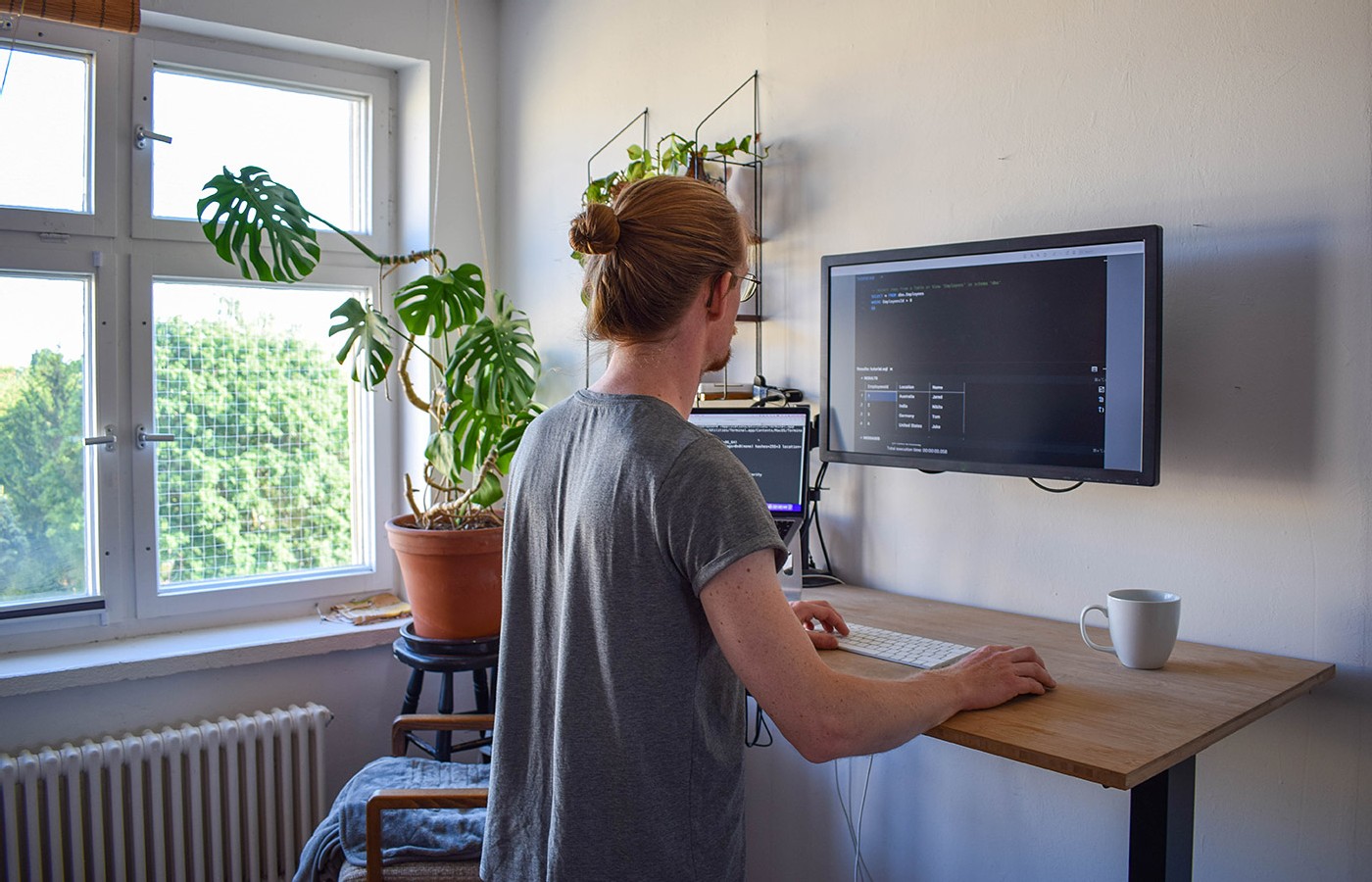
Variable-height desks do reduce the cumulative microtrauma of sitting. However, they also need to be ergonomically correct. Whether the worker is sitting or standing the same rules apply when it comes to ergonomics. The arms are bent at the elbow to 90 degrees; the head and eyes are level to the monitor; plus when standing, the hips, knees and feet need to be in alignment.
Simply put, the patient must be in anatomical neutral from their head to their feet. Sagittal-plane alignment from the ear to the ankle, as well as frontal-plane alignment with the eyes, shoulders, hips all level, is essential. Just standing is not enough – workers need to stand in anatomically correct posture.
Relevant Tip: Standing workers need shock absorption, alignment and proprioception from their feet up. Using a shock pad and appropriate work footwear are a must. In addition, short foot exercises and proprioceptive orthotics are beneficial. Although these workers are often at home, standing in slippers or stocking feet is not a good choice.
The habit of stacking bodyweight exercises lends itself to the variable-height desk worker. Since they are already standing, it is easy to add in any squat variation, calf raises, standing hip extensions, hip hikers, or lunges as microbreaks. Flexibility exercises like side bends, and hip flexor, hamstring, chest, and calf stretches, are also important.
If the patient does yoga, any standing yoga stretch would be perfect, or you can teach them the triangle or warrior poses if that is in your wheelhouse. Even standing workers need to move.
Although it is becoming less common, some hybrid workers are still working on a laptop at the kitchen counter or dining-room table while not in the office. It is nearly impossible to have strong posture while over a laptop. At-home hybrid workers need a full-size monitor, keyboard, appropriate chair and workstation. Being at home still requires good ergonomics.
For today’s hybrid worker, postural re-education must be a whole-body approach. Static postural distortions need to be addressed, as well as dynamic neuromuscular firing patterns. The cornerstone is chiropractic adjustments to restore biomechanics. From the feet to the TMJ, everything needs to move freely. Then, strengthening and proprioceptive exercises are incorporated to groove the newfound biomechanics, strengthening in anatomical neutral spine.
Even though they may be working from home, hybrid work is often a sedentary job at a computer, seated or standing. The worker’s needs are the same as the traditional office worker: proper ergonomics, corrective exercises, postural re-education, and CMT to offset deconditioning and cumulative microtrauma.
Technology has improved the work environment, but a full work week at a stationary job remains the “new smoking.” We have the skills and tools to make a difference in the hybrid worker’s quality of life.
Resources
- Azadinia F, Ebrahimi E Takamjani, et al. Can lumbosacral orthoses cause trunk muscle weakness? A systematic review of literature. Spine J, 2017 Apr;17(4):589-602.
- Pfeifer M, Begerow B, Minne HW. Effects of a new spinal orthosis on posture, trunk strength, and quality of life in women with postmenopausal osteoporosis: a randomized trial. Am J Phys Med Rehabil, 2004 Mar;83(3):177-86.