You’re Already Through Q1: How Are Your Finances Doing?
Three Real-Data Scenarios to Help Motivate You
Jamy Antoine, DC, BCN, CFP®
WHAT YOU NEED TO KNOW
For many investors, especially chiropractors, staying committed to a disciplined investing strategy can be difficult.
On a year-over-year basis, we can get discouraged, thinking our wealth-building journey is too slow. However, three scenarios using real data and real returns demonstrate how you can thrive over time.
For associate doctors and small-business owners / operators alike, the principles remain the same: Build a plan, stick to it, and avoid emotional reactions to short-term noise.
As we move into the second quarter of 2026, it’s a good time to pause and reflect. The new year is fully underway: tax season is here, and real-life schedules, staff, and cash flow have kicked back into full swing. But before we get too deep into the weeds of another busy year, it’s worth asking: How did you manage your finances in 2025, and are you on track as we end Q1 2026?
The U.S. economy in 2025 tested investors’ patience with volatility before ultimately delivering solid gains. After significant market pullbacks in the spring tied to tariffs and other uncertainties, the S&P 500 rallied throughout the year and finished strong. The S&P 500 posted roughly a 17.7% total return for the full year – a continuation of healthy performance following recent double-digit annual returns.
The lesson? Financial independence can be built through good financial choices, including consistency and time in the market, not timing the market.
On a year-over-year basis, we can get discouraged, thinking our wealth-building journey is too slow. However, I will demonstrate three scenarios using real data and real returnsfrom last year, a 10-year period, and a 20-year period. Stay tuned to the end. You’ll be amazed – and motivated. I promise.
What an Actual 2025 Portfolio Would Have Looked Like
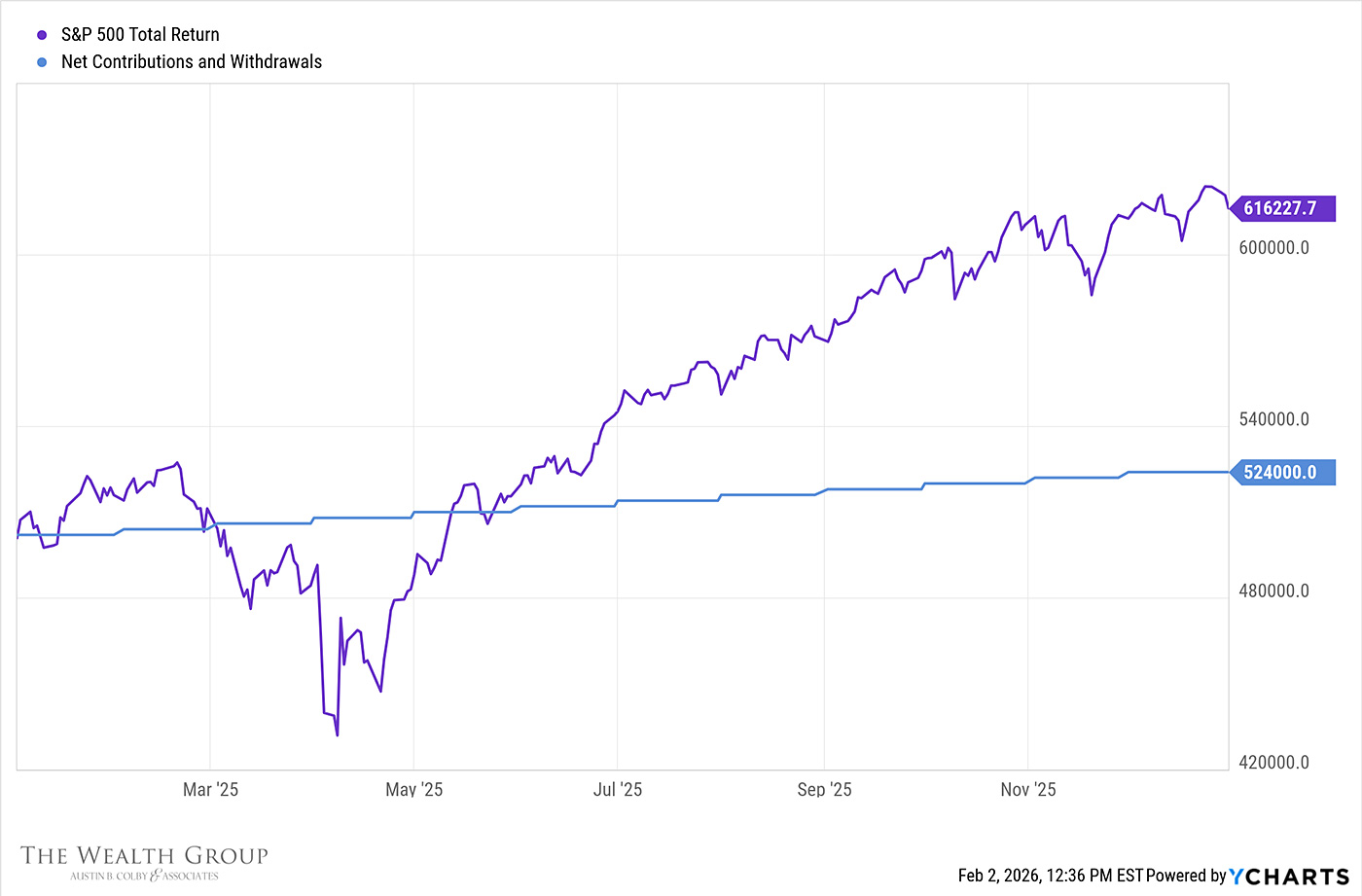
Scenario:You begin Jan. 1, 2025, with $500,000 invested in an S&P 500 index fund and contribute $2,000 every month on the first of the month.
Assumptions: You reinvest all dividends. There are no taxes. There are no fees or transaction costs to invest. You invest each monthly contribution on schedule, regardless of market direction. There is no timing of the market, or skill involved. You simply dollar cost average on autopilot.
The 2025 S&P 500 total return for this fund (SPXTR) was 17.88%. Below is a Y-Charts analysis (the gold standard of charting) of actual data of this actual fund.
What happens in Feb-April 2025? Values go down. Our stomachs sink. What happens mathematically to the number of shares we own? Nothing. If we don’t sell. If you’re in the wealth-building verses in retirement phase – meaning you’re still putting money in every month, a market drop isn’t something to fear. It’s actually a gift. You’re buying investments on sale, stacking up more shares at a lower price, and setting yourself up for bigger gains down the road.
What happens by year-end 2025?
500,000 initial investment
$24,000 invested ($2,000 monthly)
Our portfolio has grown to $616,230. Not bad, but not terribly exciting.
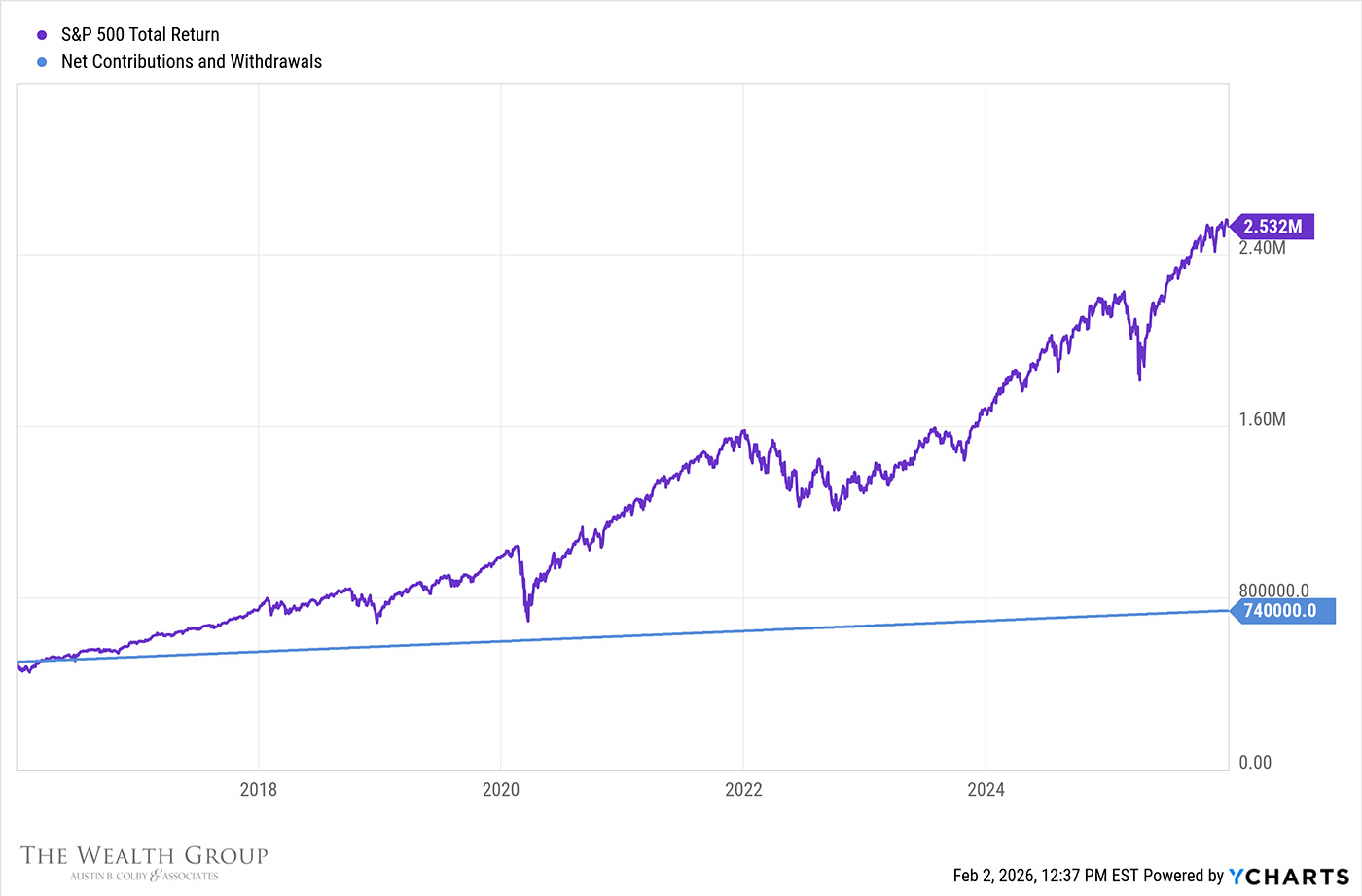
10-Year Scenario: Now, let’s do this for 10 years, again using actual data. The same scenario starts with $500,000 and $2,000 monthly for 10 years. Woah. Now we’re getting somewhere, and this is serious money.
Recap - Jan. 1, 2016 to Dec. 31, 2025:
$500,000 initial investment
Additional $240,000 invested
Our total investment is $740,000 and our portfolio has grown to $2,530,000. Very exciting.
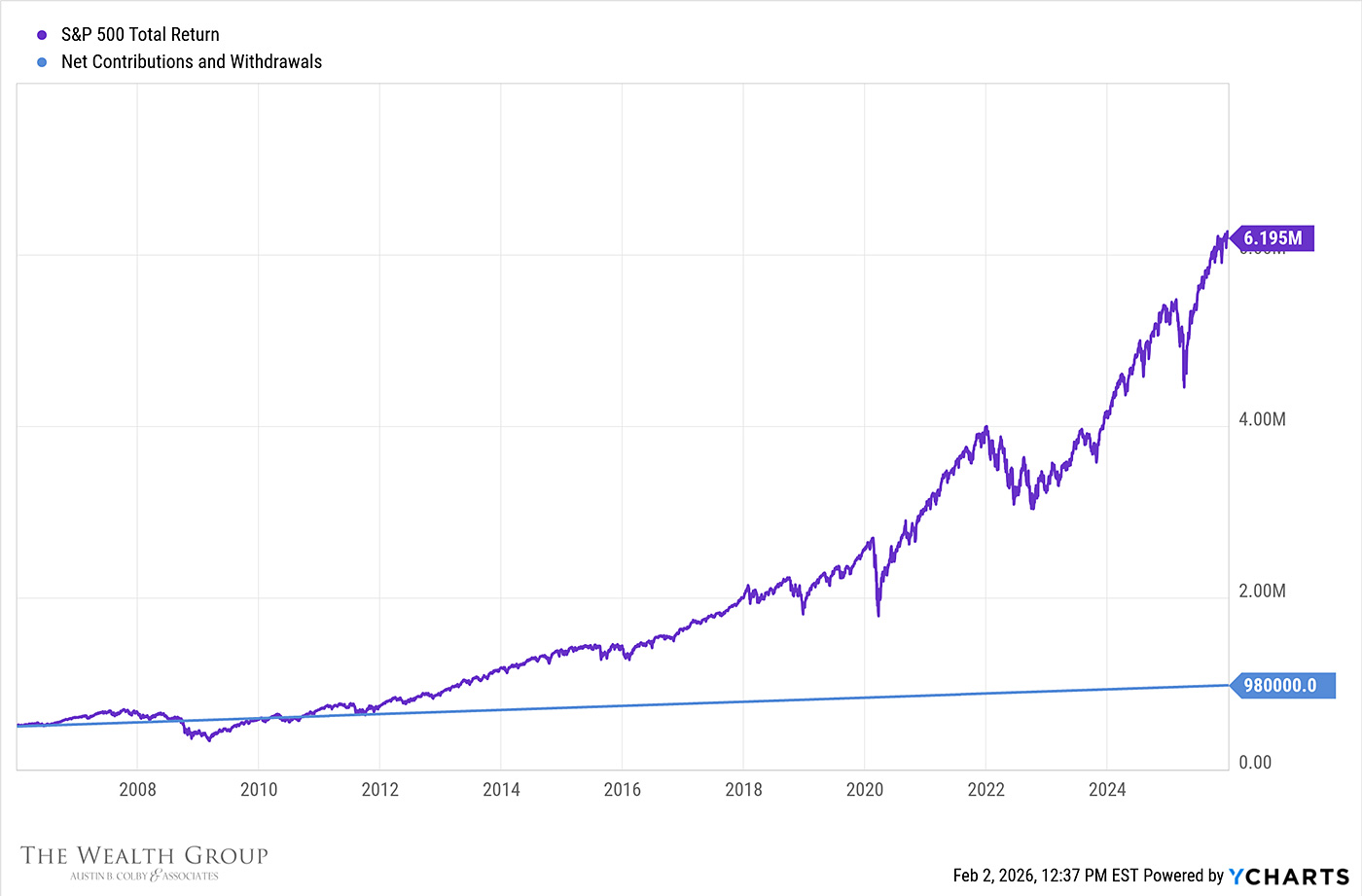
Twenty-Year Scenario: Now let’s say a now-older doctor had wisdom, patience and discipline, and was able to save $500,000 by 2005. He / she also decided to invest that same $2,000 a month for another 20 years and retired at the end of 2025. Game changing. Generational wealth.
Recap – Jan. 1, 2006 to Dec. 31, 2025
500,000 initial investment, with $480,000 in additions. Total of $980,000 invested .
Investment has grown to $6.19 million. $5.21 million in profit.
What Can We Learn Here?
When you invest consistently, you’re participating in the aggregate growth of the U.S. economy. The U.S. market represents thousands of leading companies across industries. Over long time frames, despite recessions and political nonsense, the general trend has favored growth and innovation. That doesn’t guarantee a smooth year every year, but it has historically richly rewarded disciplined and non-emotional investors.
Our Challenge as Chiropractic Doctors
For many investors, especially chiropractors, staying committed to a disciplined investing strategy can be difficult. Running a practice demands time, energy and cash. Cash flow can be unpredictable, especially in younger practices where revenue isn’t yet stable. Making regular contributions to a retirement or investment account can feel secondary to payroll, equipment upgrades, staffing, rent, and marketing, which often take precedence.
In a year like 2025, when the market moved up and down dramatically, it’s understandable that focus on the business sometimes outweighs focus on outside investments. However, this is precisely why establishing clear habits and systems matter. Setting up automatic monthly or weekly transfers to investment accounts makes it easier to stay consistent without constantly re-evaluating each week’s decision.
Over decades, these small, steady contributions compound powerfully – often more so than large, infrequent contributions timed around market headlines.
Your practice is your primary investment in your skills and your future. But financial diversification beyond your business – into the U.S. economy – provides balance and can offer financial security independent of practice performance.
For associate doctors and small-business owners / operators alike, the principles remain the same: Build a plan, stick to it, and avoid emotional reactions to short-term noise. Consistent investing lets the long-term growth of one of the most powerful economies in the world work in your favor.
Editor’s Note: The author credits Y-Charts (www.ycharts.com) for the charts outlining each data scenario included in this article.
Disclaimer: The Wealth Group is a Securities and Exchange Registered Investment Advisor. No content contained herein should be construed as an offer for investment advice or an offer for the purchase or sale of any security, insurance or other investment product. Investments involve the risk of loss, including loss of principal. Please consult with a qualified financial, tax or legal professional before implementing any strategy presented here. Data presented here is obtained from believed reliable sources, but cannot be guaranteed as to completeness or accuracy.
While cervical disc pathology can unquestionably produce radiculopathy, many patients presenting with arm pain, paresthesia or perceived weakness do not exhibit the clinical behavior of true nerve-root compromise. In these cases, failure to differentiate the primary pain generator may lead to unnecessary spinal injections, nerve ablation procedures or surgical consultation despite limited likelihood of benefit.
The New Jersey Board of Chiropractic Examiners has made a precedential decision, concurring with the Association of New Jersey Chiropractors' (ANJC) position paper on chiropractic X-ray guidelines. In plain terms, the board ruled, consistent with the ANJC position, that insurance companies cannot use medical X-ray rules or recommendations, like those written by the American College of Radiology (ACR), to decide whether a chiropractor's X-ray was necessary.
For decades, chiropractors have been told the answer to more professional referrals is simple: educate medical doctors about chiropractic. There is some truth in that advice; but it is also incomplete. The modern challenge is not simply getting another healthcare professional to know that chiropractors exist. It is becoming the kind of clinician (and building the kind of professional relationship) that makes collaboration easy and sustainable.