
Immune Function and Energy Output Support
Lack of sleep, too much stress, poor nutrition and prescription medications can draw on energy reserves, using them up faster than they can be replenished. Even the vital biologic systems can create an energy deficit that needs to be restored.
The body's cells and organ systems depend on an adequate supply of energy to function optimally. The mitochondria, known as the powerhouse of the cell, contain nutrients and enzymes that are important for recharging cellular energy production. Some of these enzymes convert food to usable energy in the form of adenosine triphosphate (ATP). ATP functions as the key source of energy for all cells. To increase mitochondrial output, there must be adequate fuel supply for combustion and abundant antioxidants to scavenge free radical by-products. Preserving energy reserves and increasing energy output is a critical part of maintaining optimal health.
Some of the most energy demanding systems in the body are:
- Liver detoxification
- Immune function
- Cardiovascular function
- Neurologic function
The Micronutrient "Backbone"
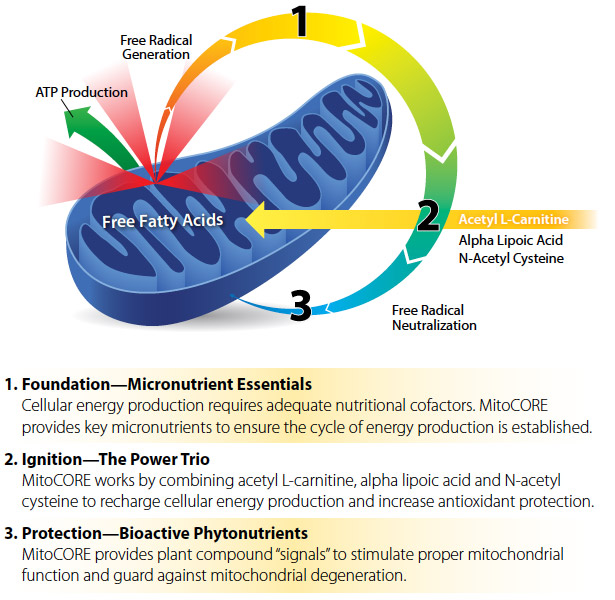
To recharge cellular energy production efficiently, optimal levels of critical nutrients and enzyme cofactors must be achieved. The powerful antioxidant trio of alpha lipoic acid, N-acetyl cysteine and acetyl L-carnitine are shown to recharge cellular energy production and the primary cellular antioxidant pools of vitamins E, C and glutathione. Key micronutrients and phytonutrients include green tea, broccoli seed extract and resveratrol, to protect the mitochondria and continually renew the cycle of energy production.
Acetyl L-Carnitine †
Acetyl L-carnitine (ALC) is an amino acid that is associated with recharged cellular energy production. It has been shown to increase the flow of free fatty acids, the fuel source for mitochondria, resulting in a significant boost in energy production. With age, free radical production increases oxidative damage to the mitochondria, which can potentially decrease energy production. ALC has been shown to recharge cellular energy production and has been found, in combination with lipoic acid, to lower oxidative stress.2,3 Studies have also shown that ALC supports immune function by protecting CD4 and CD8 immune cells and by supporting the reproduction of lymphocytes for the identification and elimination of invading antigens.4,5
N-Acetyl Cysteine †
N-acetyl cysteine (NAC) is an antioxidant that scavenges free radicals and supports detoxification capacity.6 NAC has been shown to increase production of glutathione, an important antioxidant found in the body.6 In addition to its antioxidant activity, glutathione supports immune function by activating T-cells.7
Alpha Lipoic Acid †
Alpha lipoic acid (ALA) is an antioxidant and plays a synergistic role in recharging other antioxidants such as vitamin C, vitamin E, CoQ-10 and glutathione. Lipoic acid also plays a key role in supporting detoxification capacity.8 Studies have shown that a combination of ALA and ALC helps minimize oxidative damage.9,10 Oxidative stress causes damage to DNA, RNA, proteins, mitochondrial membranes and lipids, and contributes to the functional decline of mitochondria, cells, tissues and eventually organs such as the brain.9,10
Resveratrol †
Resveratrol is a polyphenol molecule found in many plant species, including grapes and cranberries, and is found in high concentrations in wine. Polyphenols act as antioxidants that protect plants from damage that can be caused by bacteria, fungi and radiation.11 Resveratrol is believed to be the dietary factor behind the "French Paradox," which is the high rate of cardiovascular wellness in the French population, despite their high fat intake. In addition to its antioxidant properties and support for cardiovascular function, resveratrol has been shown to support immune function.11
Broccoli Seed Extract †
Broccoli seed extract contains a high amount of glucoraphanin, a compound that is a precursor to sulforaphane. Sulforaphane is an antioxidant and supports detoxification capacity and immune response. Sulforaphane has been shown to induce Phase II detoxification enzymes and raise intracellular glutathione levels.12
Green Tea (EGCG) †
Green tea polyphenols have demonstrated significant antioxidant, probiotic- and immune-supporting properties.13 The hydroxyl group of green tea polyphenols increases antioxidant protection by forming complexes with free radicals and neutralizing them, minimizing oxidative damage throughout the body. Green tea polyphenols also stimulate the activity of liver detoxification enzymes, supporting detoxification capacity.13
MitoCORE® is a multivitamin with an optimized backbone of vitamins and minerals necessary for increasing energy output and meeting daily nutritional needs. MitoCORE® is scientifically formulated, based on published research, to boost mitochondrial reserves and recharge cellular energy production. MitoCORE® supplies mitochondrial micronutrients and a smart combination of alpha lipoic acid, N-acetyl cysteine and acetyl L-carnitine to recharge energy production.

Visit OrthoMolecularProducts.com/FREE-DCMICOREA
References
- Kaiser JD, Campa AM, Ondercin JP, Leoung GS, Pless RF, Baum MK. Micronutrient supplementation increases CD4 count in HIV-infected individuals on highly active antiretroviral therapy: a prospective, double-blind, placebo-controlled trial. J Acquir Immune Defic Syndr 2006; 42(5): 523-528.
- Shigenaga M K, Hagen T M,et al. Oxidative damage andmitochondrial decay in aging. Proc Natl Acad Sci U S A. 1994; 91(23):10771-10778.
- Hagen, TM, Liu J, et al. Feeding acetyl-L-carnitine and lipoic acid to old rats significantly improves metabolic function while decreasing oxidative stress. Proc Natl Acad Sci U S A. 2002; 99(4):1870-1875.
- Di Marzio L, Moretti S, et al. Acetyl-L-carnitine administration increases insulin-like growth factor 1 levels in asymptomatic HIV-1-infected subjects: correlation with its suppressive effect on lymphocyte apoptosis and ceramide generation. Clin Immunol 1999; 92(1):103-110.
- Deufel, T. Determination of L-carnitine in biological fluids and tissues. J Clin Chem Clin Biochem 1990; 28(5):307-311.
- N-Acetylcysteine. Altern Med Rev 2000; 5(5):467-471.
- Patrick, L. Nutrients and HIV: part three - N-acetylcysteine, alpha-lipoic acid, L-glutamine, and L-carnitine. Altern Med Rev 2000; 5(4):290-305.
- Alpha-lipoic acid. Monograph. Altern Med Rev 2006; 11(3):232-237.
- Ames, B. N. Optimal micronutrients delay mitochondrial decay and age-associated diseases. Mech Ageing Dev 2010; 131(7-8):473-479.
- Ames, B. N. and Liu, J. Delaying the mitochondrial decay of aging with acetylcarnitine. Ann N Y Acad Sci 2004; 1033:108-116.
- Resveratrol: Monograph. Altern Med Review 2010; 15(12):152-158.
- Fahey JW, Talalay P. Antioxidant functions of sulphoraphane: a potent inducer of phase II detoxification enzymes. Food Chem Tox 1999:37:973-979.
- Green Tea. Altern Med Review 2000; 5(4):372-5
|
† These statements have not been evaluated by the Food and Drug Administration. This product is not intended to diagnose, treat, cure, or prevent any disease. |