
They Didn't Come to You for Their Back
The chronic patient everyone else stopped believing
Every practice has this patient. Six providers deep, a folder of normal test results, and a long history of being told - politely, repeatedly - that nothing is wrong. They hurt in more places than they can point to. They are exhausted. Most have stopped expecting anyone to believe them.
Chiropractic sees more of these patients than any other profession, and usually later than anyone else did. They are not a diagnostic puzzle you are obligated to solve. But they are, very often, a body that has been running on reserves for years: poor sleep, poor recovery, guarding that never fully switches off. By the time they reach your table, the complaint they name is rarely the whole picture.
What has changed recently is not the patient. It is what a practice can realistically deliver them between adjustments.
WHERE LASER ALREADY FITS
Class IV laser therapy is not new to this profession. Class IV lasers have been chairside in chiropractic offices for two decades, and doctors know the role: prepare tissue, take the edge off guarding, support the segment you are about to work on. Targeted energy, at the site you select, at the moment you select it. That is precision, and precision is not going anywhere.
The ceiling was never the technology. It was surface area and staff time. A ten-minute hands-on application covers one region. The chronic patient in front of you has four. Multiply that across a full schedule and the math stops working - not clinically, but operationally. Most offices ended up treating the loudest complaint and moving the rest to next visit, which is how a plan of care quietly becomes a plan for one region.
COVERAGE, AND WHAT IT COSTS THE SCHEDULE
Whole-body systems were built to remove that constraint. Instead of one emitter worked over one region by hand, an array delivers across the whole body at once, unattended, in a fixed session length. The clinical logic is unchanged. The difference is that the patient with four regions gets four regions, on the same visit, without consuming adjusting time or a staff member for the duration.
For a practice, that last part is the whole argument. Adjunctive therapy that requires a set of hands competes with your schedule. Therapy that runs unattended in a fixed fifteen minutes does not, which is why it survives a busy Tuesday - and adjunctive care only helps the patient if it actually happens on the days the office is full.
CONSISTENCY IS WHAT YOU CAN READ
Ask a doctor what limits therapy outcomes and dose consistency comes up before technology does. Hand application varies by staff member, by day, by how far behind the schedule is running. Newer systems set dose by mapping the patient rather than by whoever is holding the applicator, so visit twelve looks like visit one.
For the chronic patient, that repeatability matters more than peak output. Progress is measured over months and read off a trend. A protocol that drifts is a protocol you cannot interpret, and neither can the patient - which is where retention on passive care usually breaks down.
THE PART THAT KEEPS THEM
This patient does not stay because of a device. They stay because someone finally treated the whole picture as real, and because they can feel that the plan covers them, not just the region that hurt loudest the day they walked in. Whole-body therapy is one way to make that visible: care that does not stop being whole-person the moment they get off the table.
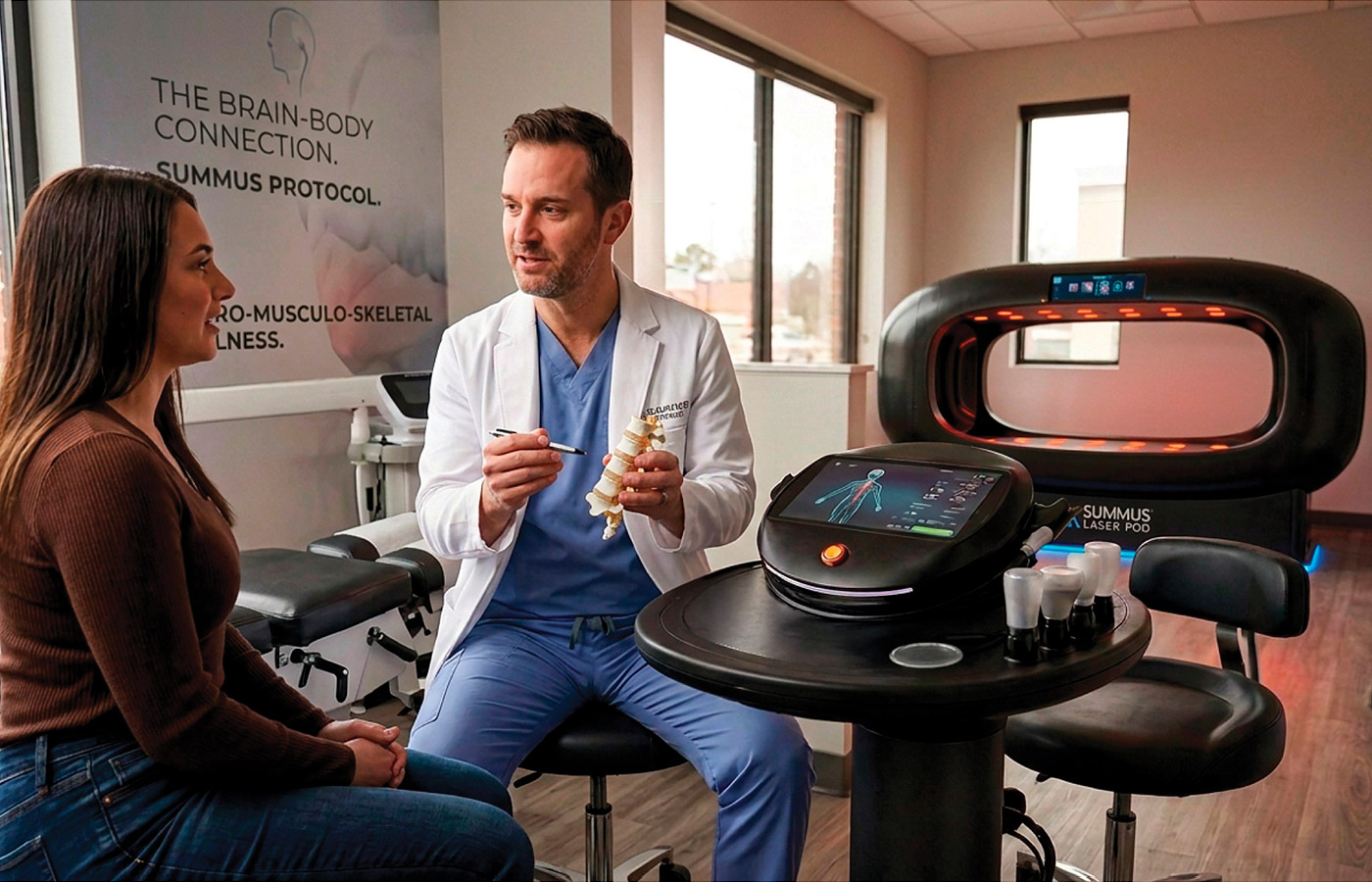
Summus Medical Laser builds both halves of that approach - the Horizon, a Class IV chairside laser under your team's direction, and the Laser Pod, a whole-body system carrying 32 Class IV lasers across seven wavelengths with mapped dosing, head to toe in fifteen unattended minutes. One is precision. The other is coverage. Neither substitutes for the other, which is why most practices adding the second already own the first.
Precision chairside. Coverage head to toe.
The Summus Horizon and Laser Pod in one operatory.
Summus Laser devices are intended to provide topical heating for the purpose of elevating tissue temperature for the temporary relief of minor muscle and joint pain and stiffness, minor arthritis pain, or muscle spasms; the temporary increase in local blood circulation; and/or the temporary relaxation of muscle. The USFDA has not cleared or approved our devices for any other clinical indications. © 2026 Summus Medical Laser, Franklin, TN.