Extending Care Beyond the Adjustment: The Case for Take-Home CBDa Protocols
What happens between visits may matter as much as what happens on the table.
Clinical outcomes are shaped as much by what occurs between appointments as by the care delivered during them. Inflammation that goes untreated between visits, persistent neuromuscular guarding, and unresolved soreness can all slow a patient's progress and shorten how long the benefits of an adjustment last. For chiropractors managing active patients, the interval between visits represents a meaningful and often unaddressed part of the care plan.
Rethinking the Interval Between Visits
Chiropractic care has long incorporated home-based components: stretching protocols, ice or heat application, ergonomic adjustments. Topical CBDa fits within this same category of interval-based support, not as a retail add-on, but as a clinical extension of the treatment plan itself. That distinction matters: it's recommended by the chiropractor as part of a structured plan, not left to the patient's own discretion.
The rationale is grounded in mechanism. Naturally occurring CBDa (cannabidiolic acid found in raw cannabis and hemp has demonstrated COX-2 inhibitory activity in preclinical research, the same inflammatory pathway targeted by NSAIDs, but without the associated gastrointestinal risk profile.1 Applied consistently between visits, a topical CBDa formulation may help maintain a lower inflammatory baseline heading into each subsequent appointment, allowing recovery to build on a more settled physiological state rather than starting over each time.
Why the Interval Matters Clinically
Patients managing chronic tendon irritation, recurring hotspots, or high physical loads between visits are frequently the ones who plateau, not because the adjustment itself was ineffective, but because the inflammatory and neuromuscular environment resets before the next session. Interaction with TRPV1 receptors and serotonergic pathways involved in pain signaling has been proposed as a mechanism by which CBDa may reduce this reactivity between visits, supporting more consistent depth and duration of correction over time.2
This is a clinical rationale, not a promise of outcome. The available evidence is largely preclinical and observational, and formal controlled trials specific to interval-based use remain limited. What exists supports plausibility, not certainty.
A Note on Compliance and Product Selection
For practices treating competitive athletes, any interval-based recommendation must meet the same compliance bar as in-office care. Non-detectable levels of THC (less than 0.003%), third-party testing, and manufacturing in an NSF Safe for Sport certified facility are baseline requirements, not differentiators, when a recommendation is meant to hold up to organizational scrutiny (WADA/USADA, NCAA, or professional league standards).
Clear labeling and accessible Certificates of Analysis are what allow a practitioner to stand behind a take-home recommendation with the same confidence as an in-office modality.
The Practical Question for Practices
The mechanistic case for interval-based CBDa use is reasonably well supported. The more useful question for most practices is whether formalizing this as part of the care plan, rather than treating it as an optional add-on, changes patient trajectories over a course of care.
Early clinical reports suggest it may: patients return to the table with less residual inflammation and less guarding, and adjustments that appear to hold longer as a result. As with any adjunct, the underlying manual work remains the primary driver of outcome. CBDa does not replace technique. It may prolong what that technique achieves between visits. That's the distinction that matters: this is a clinician-directed extension of care, not a self-selected retail product. It's that structure that lets practices stand behind it with the same confidence as any other modality on the treatment plan.
For educational purposes only. This content has not been evaluated by the Food and Drug Administration. Not intended to diagnose, treat, cure, or prevent any disease.
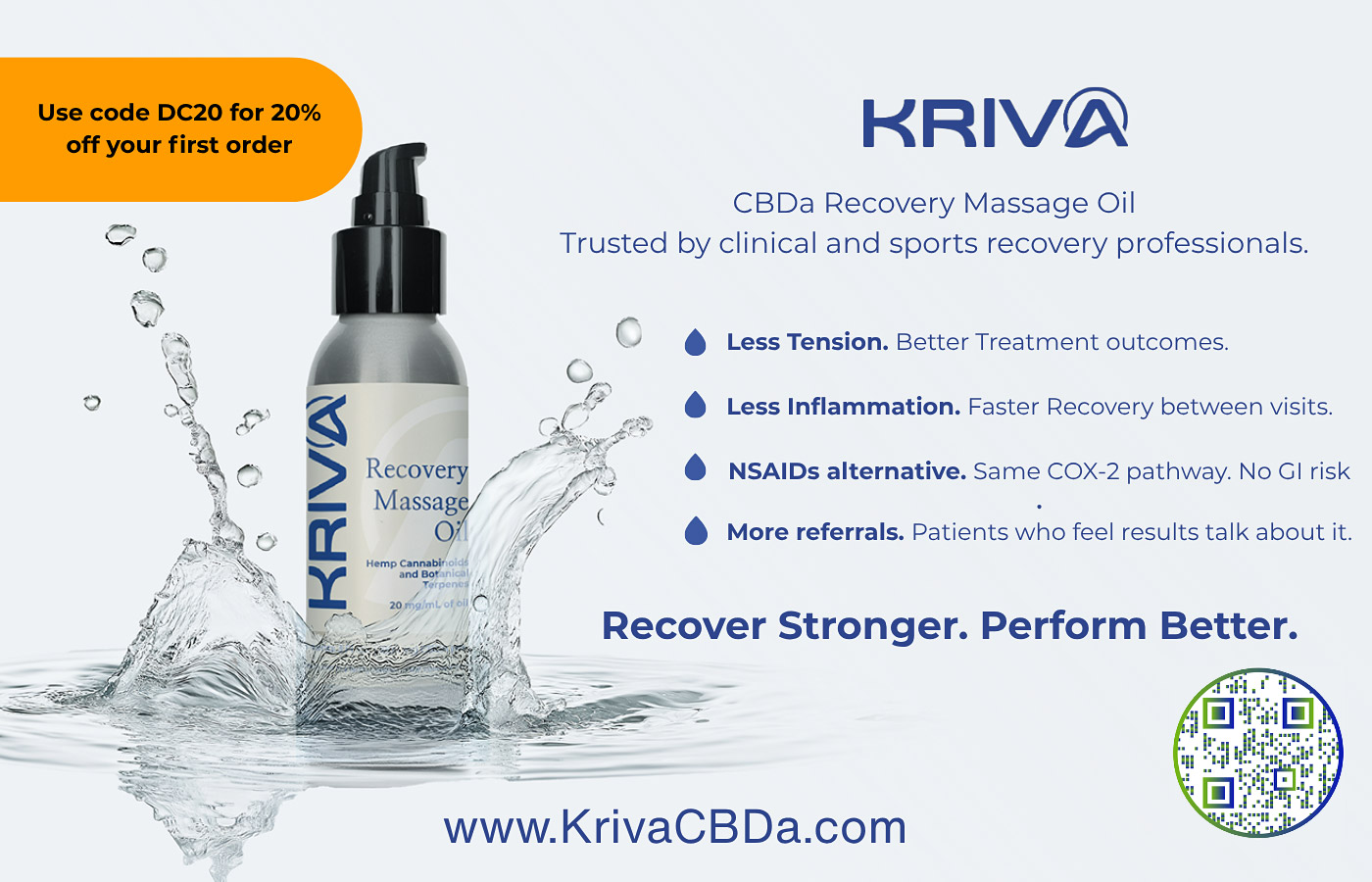
Use code DC20 for 20% at KrivaCBDa.com
References
- Takeda S, Misawa K, Yamamoto I, Watanabe K. Cannabidiolic acid as a selective cyclooxygenase-2 inhibitory component in cannabis. Drug Metabolism and Disposition. 2008;36(9):1917–1921.
- Rock EM, et al. Effect of cannabidiolic acid and delta-9-tetrahydrocannabinol on carrageenan-induced hyperalgesia and edema in a rodent model of inflammatory pain. Psychopharmacology. 2018;235(11):3259–3271.