
Cartilage and Blood Flow:
The Ignored Pairing in Joint Health
Tom Bayne, DC
Osteoarthritis is often viewed as a disease of worn-out cartilage. While cartilage degeneration is certainly a defining feature, focusing exclusively on cartilage may cause clinicians to overlook one of the most important factors influencing joint health: microcirculation.
This distinction matters because cartilage degeneration is remarkably common. Large imaging studies have demonstrated that structural cartilage changes are present in many individuals long before symptoms develop. In fact, evidence of cartilage degeneration can be found in a significant percentage of asymptomatic adults, suggesting that joint deterioration often begins years before pain becomes apparent.
The progression toward osteoarthritis is driven by a shift in the balance between anabolic and catabolic processes within the joint. Healthy cartilage is constantly being renewed and repaired. However, inflammatory mediators, oxidative stress, and metabolic dysfunction can tip the scales toward degeneration, resulting in progressive breakdown of joint tissues.
Recent clinical research has demonstrated that targeted nutritional interventions can positively influence this process. A randomized, placebo-controlled clinical trial evaluating standardized extracts of Boswellia serrata and Apium graveolens found significant improvements in both symptoms and objective biomarkers of cartilage metabolism. Participants experienced substantial reductions in pain and stiffness while simultaneously demonstrating decreases in cartilage degradation markers, including serum and urinary CTX-II. Even more impressive, biomarkers associated with cartilage regeneration, including PIIANP and PIICP, increased significantly. These findings suggest that nutritional interventions can influence not only symptoms, but the underlying biology of cartilage turnover.
Yet cartilage support may represent only part of the solution.
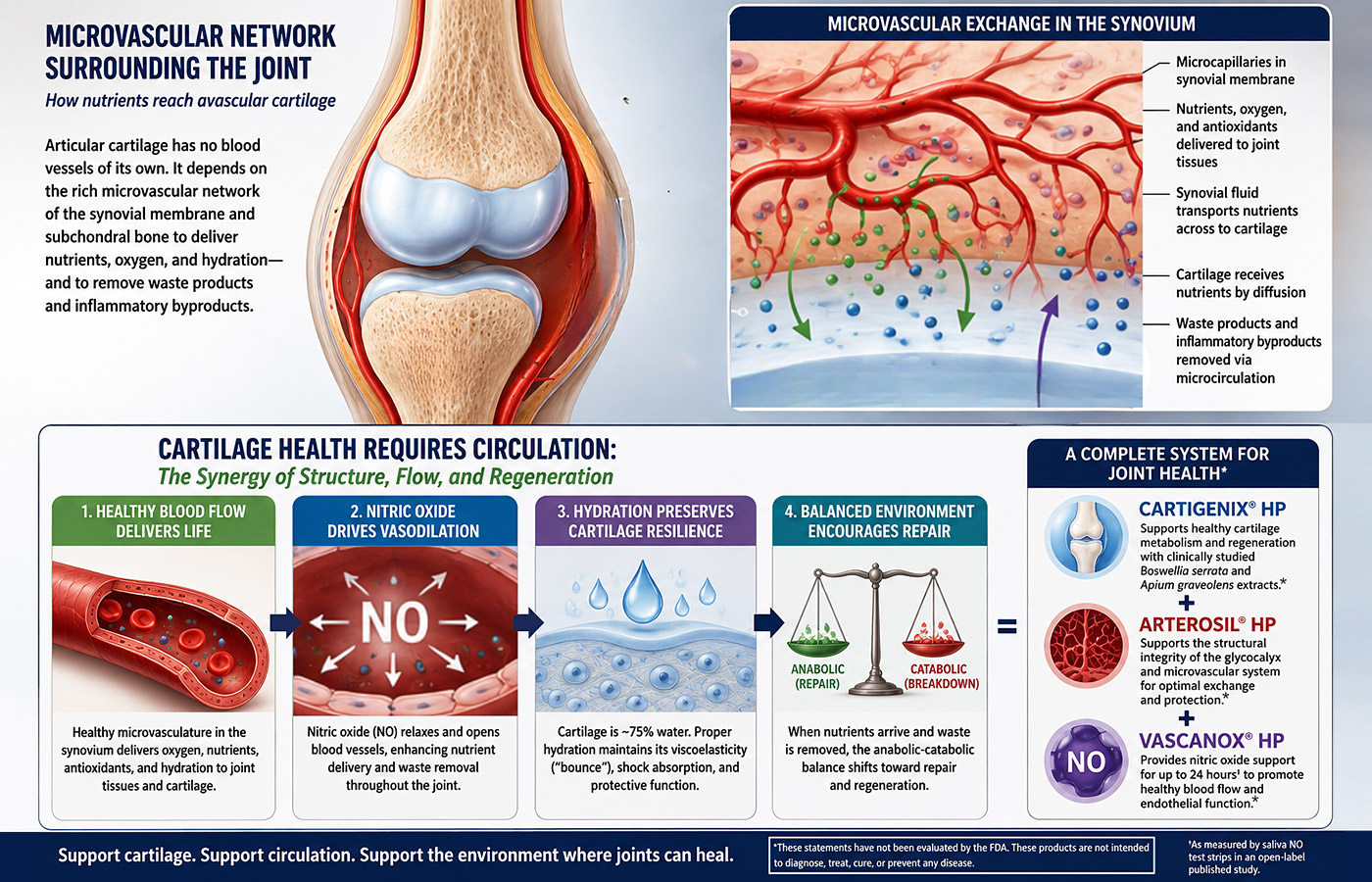
One of the unique challenges of cartilage health is that cartilage itself is avascular. Unlike muscle, skin, or many other tissues, cartilage does not contain its own blood vessels. Because of this, many practitioners assume circulation plays a minimal role in joint health.
The opposite is true.
Although cartilage lacks direct blood supply, it relies heavily on surrounding tissues and microvascular networks for the delivery of oxygen, nutrients, antioxidants, hydration, and cellular signaling molecules. The synovial membrane contains an extensive microvascular system responsible for supplying the materials necessary to maintain a healthy joint environment. Nutrients must travel through this microcirculatory network before ultimately reaching cartilage tissue.
Microcirculation also serves another critical function: removal of metabolic waste products and inflammatory byproducts. When inflammatory mediators accumulate, catabolic pathways become more active and cartilage degradation accelerates. Healthy microvascular exchange helps maintain a more favorable environment where repair mechanisms can function efficiently.
Nitric oxide is a key regulator of this process. By promoting healthy vasodilation, nitric oxide supports blood flow through the microvascular network, helping ensure that nutrients and oxygen can reach tissues while metabolic waste products are efficiently removed. Adequate nitric oxide production is therefore an important component of maintaining healthy tissue function throughout the body, including the joints.
Hydration represents another overlooked aspect of joint health that is closely tied to circulation. Cartilage is composed of approximately 75% water. This high water content is largely responsible for its ability to absorb compressive forces and act as a shock absorber during movement. Research has shown that hydration status significantly influences the biomechanical properties of cartilage. When hydration is compromised, cartilage becomes less resilient and less capable of protecting joint surfaces.
Maintaining proper hydration within joint tissues depends on healthy nutrient and fluid exchange through the surrounding microvasculature. In many ways, the health of cartilage and the health of the microcirculation are inseparable.
This understanding creates a compelling biological rationale for a comprehensive approach to joint health. Supporting cartilage regeneration while simultaneously supporting microvascular structure and function may provide a more complete strategy than either approach alone.
In my clinical approach, I often view these systems as partners. Cartigenix HP provides targeted support for healthy cartilage metabolism and regeneration. Arterosil HP supports the structural integrity of the glycocalyx and microvascular system. Vascanox HP provides nitric oxide support that helps maintain healthy endothelial function and blood flow for up to 24 hours as measured by saliva nitric oxide test strips in an open-label published study.
While each product addresses a distinct aspect of physiology, together they support the biological systems that allow joints to function optimally.
The prevalence of osteoarthritis continues to rise as populations age and metabolic dysfunction becomes increasingly common. As clinicians, we must move beyond the simplistic view that joint health is solely about cartilage. Cartilage exists within a complex biological ecosystem that depends on circulation, nutrient delivery, waste removal, endothelial function, and hydration.
When we consider both cartilage health and microcirculatory health together, we gain a more complete understanding of how joints maintain resilience throughout life.
In the future, the most effective joint support strategies may not focus on cartilage alone. They may focus on the environment that allows cartilage to thrive.
About Tom Bayne
Dr. Tom Bayne is a Chiropractic Physician who has practiced and worked in the field of Functional Medicine for almost 30 years. Dr. Bayne worked with a team of physicians and microbiologists to create MegaSporeBiotic®, the world's first pharmaceutical-grade, 100% spore-based probiotic. This innovation marked the beginning of Microbiome Labs, where he served as President. He traveled globally to educate healthcare practitioners on the connection between the gut microbiome and various chronic conditions.
Since his exit in 2023, Tom has Co-founded 3 other companies in the Health and Wellness space with the goal of providing cutting edge solutions to some of today's most concerning health issues by providing clinically proven technologies and ingredients that improve human health.
About Calroy Health Sciences
At Calroy, we don't follow trends—we set them. And we don't just follow the science—we advance it. Calroy creates products without parallel: clinically tested, category-defining solutions that support long-term health by targeting the systems and structures most others overlook. From launching the groundbreaking, gold-standard supplement for endothelial glycocalyx support (Arterosil HP) to the first nitric oxide product to provide up to 24 hours of support on a single dose (Vascanox HP), we pioneer breakthroughs that deliver meaningful outcomes.* Calroy is proud to bring you Cartigenix-HP for cartilage support.*
|
*These statements have not been evaluated by the Food and Drug Administration. This product is not intended to diagnose, treat, cure or prevent any disease. |
Further Reading and References:
- Blasioli DJ, Kaplan DL. The roles of catabolic factors in the development of osteoarthritis. Tissue Eng Part B Rev. 2014;20(4):355-363. doi:10.1089/ten.TEB.2013.0377.
- Blazek AD, Nam J, Gupta R, et al. Exercise-driven metabolic pathways in healthy cartilage. Osteoarthritis Cartilage. 2016;24(7):1210-1222. doi:10.1016/j.joca.2016.02.004.
- Desai A, Anand S, Nair* S, Chorghe P. Assessing the effectiveness and NSAIDs sparing effect of celery seeds and Boswellia serrata in osteoarthritis management. Indian Journal of Orthopaedics Surgery. 2024;10(4). doi:10.18231/j.ijos.2024.052.
- Desai DA, Shendge DP, Anand DS, Nair DS. Clinical effectiveness and tolerability of Celery seed and Boswellia serrata extract in osteoarthritis. Int J Orthop Sci. 2022;8(2):248-252. doi:10.22271/ortho.2022.v8.i2d.3143.
- Hardingham, T. "Chapter 6: Cartilage Tissue Regeneration." Electrospinning for Tissue Regeneration. 2011; ScienceDirect. Accessed January 30, 2026.
- Levick JR. Microvascular architecture and exchange in synovial joints. Microcirculation. 1995;2(3):217-233. doi:10.3109/10739689509146768.
- Pearson B, Espino DM. Effect of hydration on the frequency-dependent viscoelastic properties of articular cartilage. Proc Inst Mech Eng H. 2013;227(11):1246-1252. doi:10.1177/0954411913501294.
- Simkin PA, Bassett JE. Pathways of Microvascular Permeability in the Synovium of Normal and Diseased Human Knees. The Journal of Rheumatology. 2011;38(12):2635-2642. doi:10.3899/jrheum.110785.
- Smith JK. Exercise as an Adjuvant to Cartilage Regeneration Therapy. Int J Mol Sci. 2020;21(24):9471. doi:10.3390/ijms21249471.
- Vaidya N, Agarwal R, Dipankar DG, et al. Efficacy and Safety of Boswellia serrata and Apium graveolens L. Extract Against Knee Osteoarthritis and Cartilage Degeneration: A Randomized, Double-blind, Multicenter, Placebo-Controlled Clinical Trial. Pharm Res. Published online January 28, 2025. doi:10.1007/s11095-025-03818-2.