
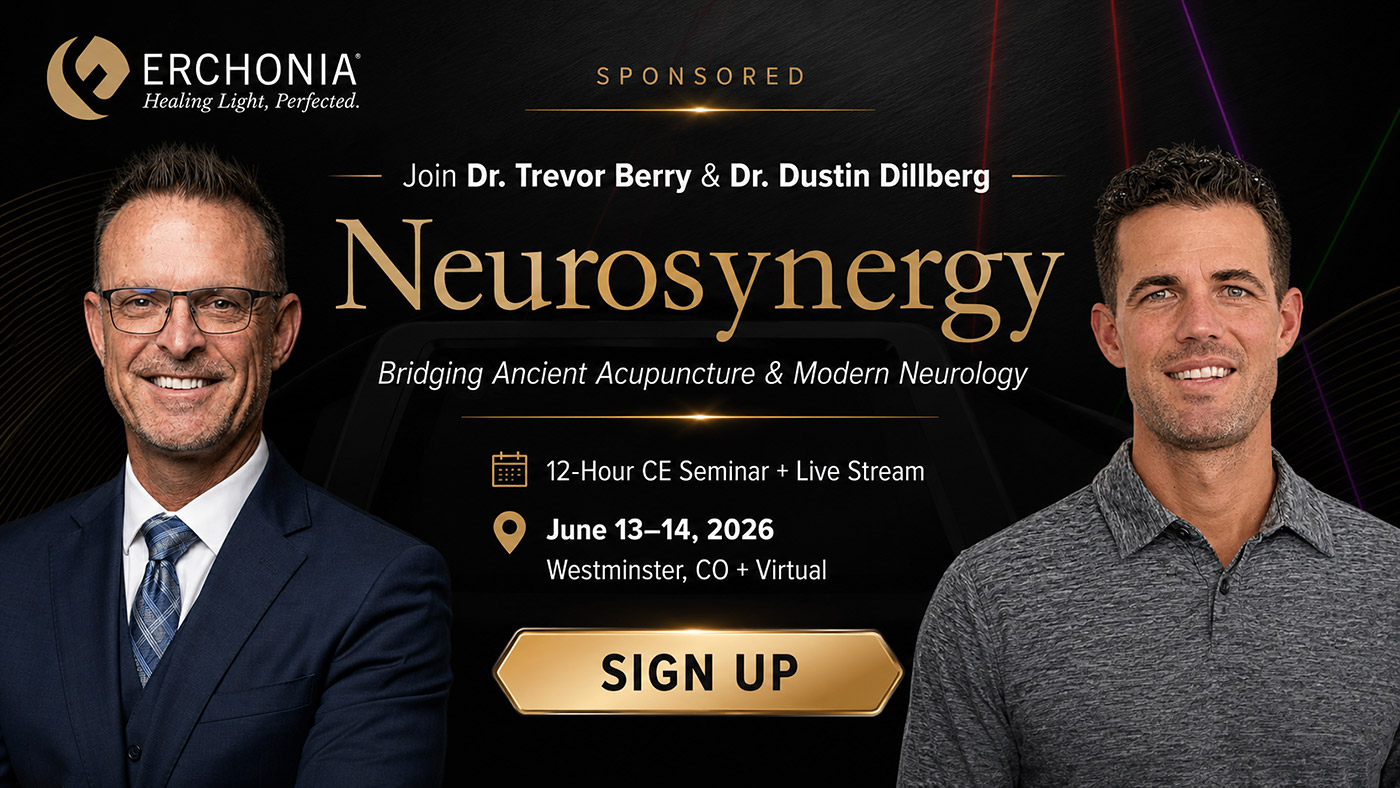
Neurosynergy:
Bridging Ancient Acupuncture & Modern Neurology
By Dr. Trevor Berry, DC, DACNB
For modern clinicians, neurological care is moving beyond isolated pain management and into a more systems-based understanding of the body. Pain, movement, inflammation, autonomic regulation, metabolism and recovery are all influenced by how the nervous system communicates with the body — and how the body communicates back.
This is where the integration of acupuncture, functional neurology and low-level laser therapy becomes clinically compelling.
The Nervous System as the Central Regulator
The nervous system is not simply a wiring system. It is a dynamic communication network that interprets input from muscles, joints, organs, inflammation, metabolic stress and sensory receptors. When that input becomes distorted, the result may be pain, poor movement, reduced recovery, autonomic imbalance or chronic neurological stress.
A neurological model of care asks a deeper question: How can we provide better input to help the nervous system regulate more efficiently?
Ancient Principles, Modern Physiology
Acupuncture has long viewed the body as an interconnected system through concepts such as Qi, Yin and Yang, Five Elements and channel theory. Modern neuroscience gives us another way to examine that same interconnectedness.
Acupuncture points often correspond with areas rich in nerve endings, connective tissue, vascular structures and sensory pathways. From a neurological perspective, acupuncture may be understood as a precise form of sensory input capable of influencing peripheral signaling, spinal cord processing, autonomic tone and brain-based regulation.
Where Low-Level Laser Therapy Fits
Non-thermal low-level laser therapy adds another layer to this clinical model. Instead of relying on heat or tissue disruption, specific wavelengths of light can create photochemical interactions within the body, particularly at the mitochondrial level.
Because mitochondria play a central role in ATP production, oxidative stress, inflammation and cellular repair, laser therapy can become a valuable tool for supporting tissue communication and neurological function. When combined with acupuncture principles and brain-based clinical reasoning, it gives practitioners a more advanced way to approach complex neurological cases.
The Future of Integrative Neurological Care
The future of care belongs to clinicians who can connect the dots between the nervous system, acupuncture pathways, mitochondrial function, the gut–brain axis, vagal influence, muscle metabolism and neuroplasticity.
Want to see how this is applied in practice?
Join Dr. Trevor Berry and Dr. Dustin Dillberg live for Neurosynergy: Bridging Ancient Acupuncture & Modern Neurology, a 12-hour CE seminar available in person in Westminster, CO, or by live stream June 13–14, 2026.