CBDa in Active Recovery: What You Need to Know
Unprocessed CBD precursor offers stronger anti-inflammatory benefits for your recovery protocols.
Most clinicians are familiar with CBD. Far fewer know that CBDa (cannabidiolic acid, the raw form found in Cannabis sativa before heat is applied) could be the more clinically relevant compound for the patients in your practice. Integrated alongside spinal adjustments, soft tissue work, and modalities like Graston or cupping, emerging research suggests topical CBDa could meaningfully reduce inflammatory load, decrease neuromuscular reactivity, and allow the body to respond more fully to each form of care.
CBDa vs. CBD: Why the Distinction Matters
CBD is produced when CBDa is heated during extraction — a conversion that is irreversible. Emerging research suggests CBDa may demonstrate stronger anti-inflammatory activity than CBD in certain biological pathways, and at lower concentrations.1,2,3
Four Mechanisms Relevant to Chiropractic and Active Recovery
Inflammation modulation. CBDa has been shown to reduce pro-inflammatory cytokines associated with exercise-induced muscle damage and spinal loading. A 2008 study in Drug Metabolism and Disposition found CBDa demonstrated COX-2 inhibitory activity with 9-fold higher selectivity for COX-2 over COX-1 — the same pathway targeted by NSAIDs, but without systemic GI risk.1 A 2025 bioavailability study confirmed this mechanism and noted a potentially stronger anti-inflammatory effect vs. CBD.3
Pain regulation. Interaction with TRPV1 receptors and serotonergic pathways can reduce nociceptive signaling.2 For patients who guard during care or whose pain sensitivity limits adjustment depth, lowering neurological reactivity means you can work deeper, corrections hold longer, and patients get more from every session.
Neuromuscular relaxation. Cannabinoid activity at the neuromuscular junction may modulate acetylcholine release, contributing to reductions in excess muscle tension.5,6 CBDa may reduce the muscular guarding that limits the duration of a correction. Findings to date are primarily preclinical.
Localized and systemic action. Topical CBDa concentrates activity at the treatment site while research on transdermal delivery confirms measurable systemic absorption, with dose-dependent reductions in pro-inflammatory biomarkers in surrounding tissue.4 For patients under high training loads, CBDa works on the broader inflammatory environment — not just the pain site.
Clinical Evidence
A 29-day observational study of 148 participants using Kriva's CBDa topical formulation found statistically significant reductions in pain severity, pain interference, and overall pain outcomes. Participants reported an average 40.9% reduction in composite pain scores, and 83% agreed the product was effective at reducing daily pain.7 These findings support CBDa's role as a meaningful adjunct in hands-on recovery care.
Safety and Compliance
Topical CBDa is generally well tolerated; risks are primarily limited to skin sensitivity or reactions to carrier ingredients. Patch testing is recommended. Broad-spectrum, THC-free formulations produced in NSF Certified for Sport facilities are compatible with WADA/USADA guidelines, the NCAA, and all professional sports leagues in the USA. Third-party testing and transparent labeling are non-negotiable criteria for any clinical recommendation.
For educational purposes only. This content has not been evaluated by the Food and Drug Administration. Not intended to diagnose, treat, cure, or prevent any disease. Where CBDa-specific studies are limited, referenced research on CBD is included given the shared biological pathways between the two compounds. CBDa is the unprocessed precursor to CBD and acts on overlapping receptor systems.
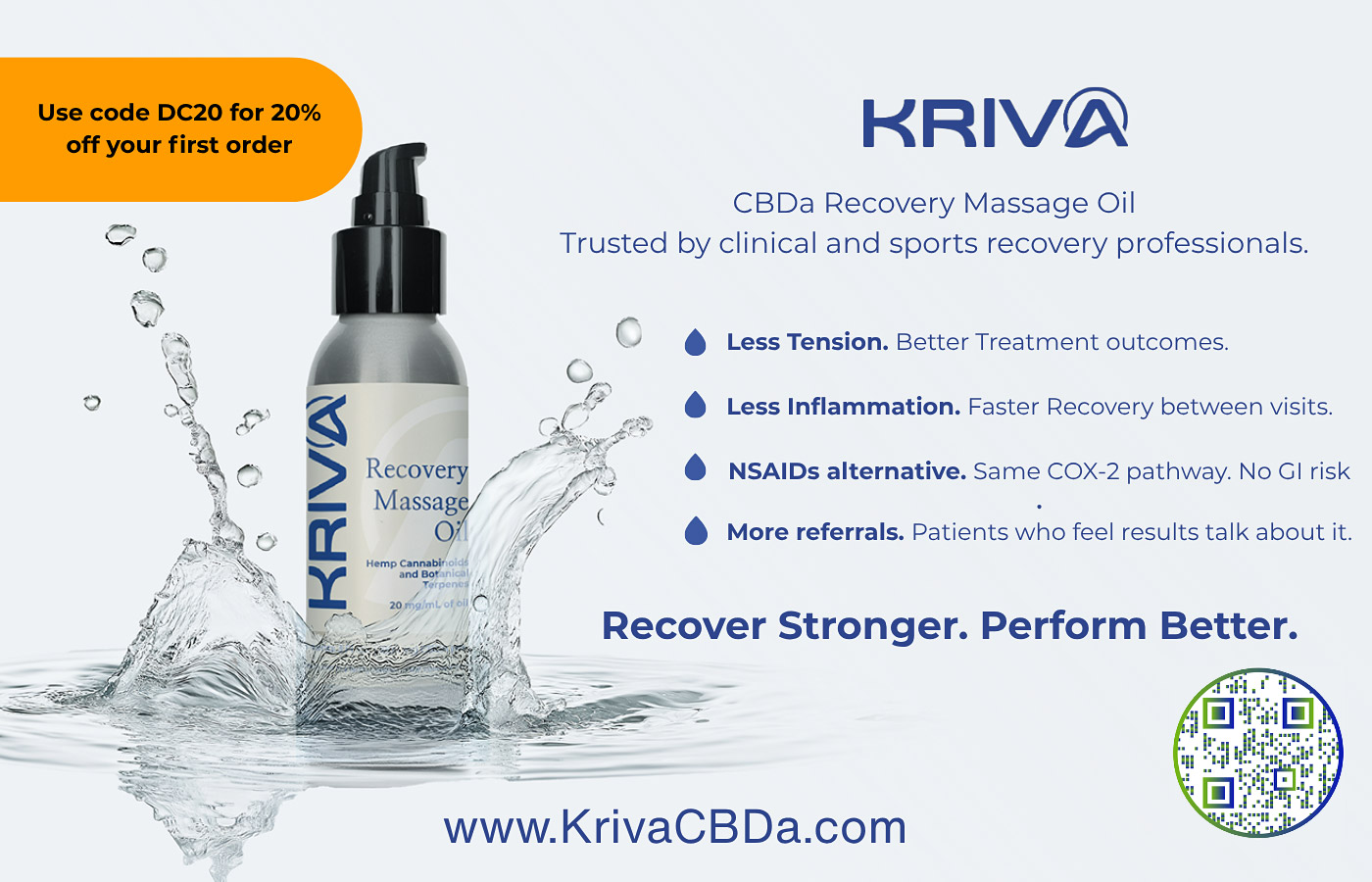
Use code DC20 for 20% at KrivaCBDa.com
References
- Takeda S, et al. Drug Metabolism and Disposition. 2008;36(9):1917–1921.
- Rock EM, et al. Psychopharmacology. 2018;235(11):3259–3271.
- Izzo I, et al. European Journal of Pharmaceutics and Biopharmaceutics. 2025. doi:10.1016/j.ejpb.2025.114670.
- Hammell DC, et al. European Journal of Pain. 2016;20(6):936–948.
- Bhumbra GS, Bhatt DL. Neuroscience Letters. 2020;720:134742.
- Lopez-Reyes I, et al. Biomedicines. 2025;13(4):844.
- Kriva Everyday Wellness Lotion Pain Topical Report. MoreBetter. Data on file; forthcoming at krivacbda.com.