Help Your Patients Develop a Killer Core – Without Crunches
Donald DeFabio, DC, DACBSP, DABCO
WHAT YOU NEED TO KNOW
Bent-leg sit-ups, V-ups, hanging leg raises, bicycle crunches, and standard crunches are not the best exercises for stability and endurance of your intrinsic core muscles. In fact, they may actually lead to an increased risk of lumbar disc disorders.
To treat and prevent low back pain, symmetry and endurance of the intrinsic core stabilizer muscles are essential.
In addressing the core, the research points to plank variations, McGill curl-ups, bridges, and bird dog variations as excellent choices. Core stability does not include washboard abs and hip flexor-dominant movement patterns.
Bent-leg sit-ups, V-ups, hanging leg raises, bicycle crunches, and standard crunches are not the best exercises for stability and endurance of your intrinsic core muscles. In fact, they may actually lead to an increased risk of lumbar disc disorders. To treat and prevent low back pain, symmetry and endurance of the intrinsic core stabilizer muscles are essential.
First, it’s necessary to review the concept of global prime movers versus stabilizer muscle groups. While these are broad categories and many muscles provide both functions, the take-home is that primer movers are designed to create motion, power, force, and speed. These muscles are generally large and superficial. Examples include the quadriceps, hamstrings, pectoralis, and latissimus.
In contrast, stabilizer muscles are smaller, deeper, provide little joint motion and create a firm (stable) foundation for the prime movers to act upon. Functional movement clinicians use the phrase, “Proximal stability creates distal mobility,” implying the stabilizers are essential for efficient multiplanar movement. While this classification is not absolute, it must be considered in exercise selection for low back pain patients The stabilizers must be selectively engaged for comprehensive low back rehab.
Relevant Tip: The rectus abdominus and iliopsoas are considered global prime movers, not stabilizers. This explains why the chronically fit patient with washboard abs who cycles and runs for cardio (both hip flexor-dominant activities) has recurring or even acute-onset low back pain.
As stated above, stabilizers are generally deeper muscles. In the lumbopelvic hip complex, that points directly to the transverse abdominus (TA). As with any muscle, creating neuromuscular control to activate the TA is the first step in creating strength, stability and endurance. For patients who are disassociated with their TA, the abdominal drawing-in maneuver is a good place to start.
However, the Prague School teaches a concept of a 360-degree expansion of the abdominal cannister. This technique offers more motor recruitment than the drawing-in maneuver, but also increases compression on the lumbar discs.
Relevant Tip: A technique to help patients develop motor control of the TA is to palpate for its contraction while drawing in and with the 360 Prague brace. The TA can be found by sliding your fingers medially off of the ASIS while remaining lateral to the iliopsoas. The TA can be felt to contract under your fingers.
Next, it is important to note that the diaphragm and pelvic floor are significant stabilizers for the LPHC. In fact, activation of the diaphragm can be incorporated in the early stages of treating an acute low back pain – simply add diaphragmatic breathing. In addition to offering stability, controlled breathing helps to oxygenate the body, which is also beneficial for healing.
Since eccentric contractions create more tension over time, a common prescription with diaphragmatic breathing is for the inspiration:expiration ratio to be 1:2.
Masroor documented that combining diaphragmatic breathing with core stability exercise outperformed core stability exercises alone. He preferred drawing in to engage the TA but also paired his diaphragm contractions with the elevation of the pelvic floor, as described by the Prague School. As with all exercise prescriptions, the patients were progressed with increasing levels of complexity.
Relevant Tip: Diaphragmatic breathing can be stacked with any exercise to add an additional layer or challenge, stability and motor recruitment. From TMJ to ankle rehab, it can always be included.
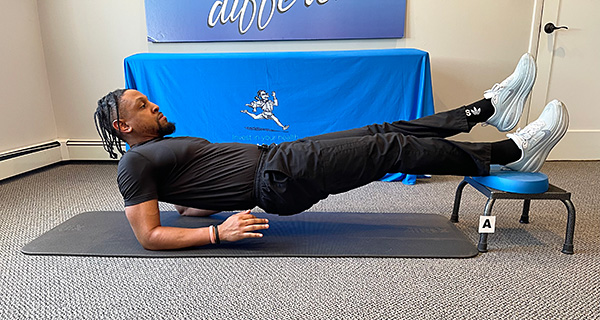
PHOTO A: Posterior power line.
McGill’s top three exercises for low back rehab include the side plank, bird dog and curl-up. These exercises are considered a mainstay in low back rehab and avoid hip flexor and rectus abdominus activation. They also follow a progression and can be adapted for the acute, subacute, and return-to-function stages of care.
The essential point in McGill’s approach is exercise selection that has a low load on the intervertebral discs – considered spine sparing. A complete review of his progressions can be found in a previous article in this column (February 2018).
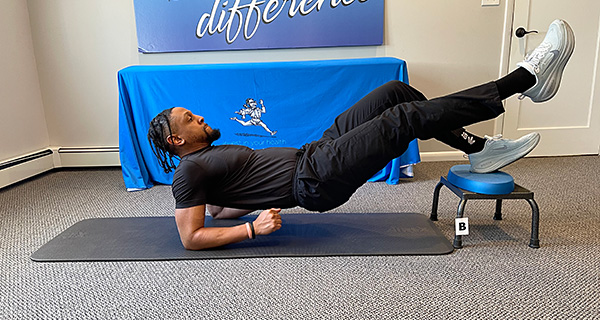
PHOTO B: Posterior stabilization line.
Tomschi presents a 10-minute isometric workout for chronic low back pain. Isometric exercises do create more compression, and one of his exercises is actually one of McGill’s five worst exercises for the low back due to its high compression load. Tomschi utilized five exercises in rotation for 10 minutes, holding each for 30 seconds with a 10-second rest (approximately three sets). The exercise order was front plank, Superman’s, side plank (right and left), and supine bridge.
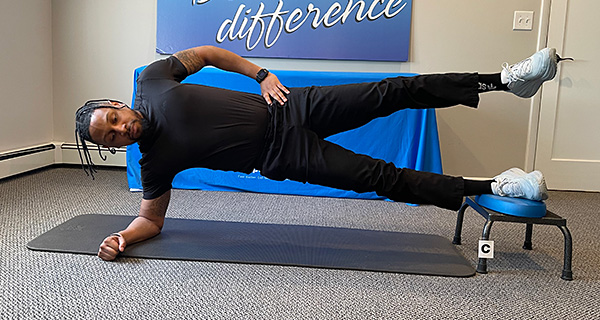
PHOTO C: Lateral stabilization line.
He found this protocol did create exercise induced analgesia in the lumbar spine without any systemic effects. (McGill does not recommend the Superman exercise). Again, notice the global prime movers are not engaged and there are no crunches, either!
Athletic and chronically fit patients are a subset of our practices. These patients need to be challenged and progressed with tangible goals. The exercise selection for them happens to also be the assessment for dysfunctions: the Bunkie test. A major benefit in the Bunkie test is it can isolate imbalances. An imbalance of greater than 10% between left / right or front / back is both a predictor of injury and a cause of recurring back pain.
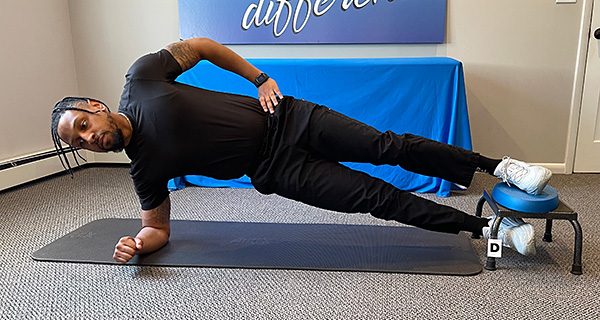
PHOTO D: Medial stabilization line
There are five positions in performing a Bunkie test, each done with a single leg. This is the critical component for establishing asymmetries in strength and stability. Successful completion is 20-40 seconds with no pain and excellent technique. It can also be used to develop endurance by reducing the hold time to 2-6 seconds for six sets.
Relevant Tip: To obtain maximal results when performing stability exercises, it is essential to engage (contract) the local stabilizers before movement occurs. This ensures maximal activation of both the stabilizers and prime movers.
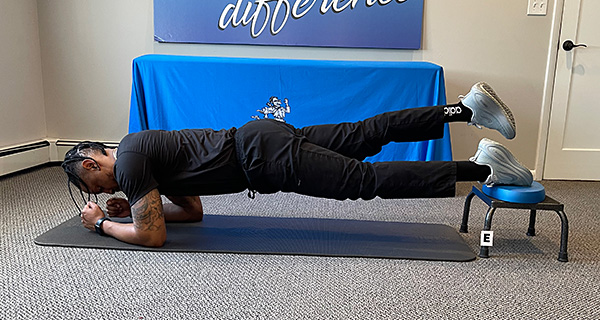
PHOTO E: Anterior power line – prone plank with ankle plantarflexion.
Rehabilitative exercises need to be performed correctly and they need to be selective for the patient. In addressing the core, the research points to plank variations, McGill curl-ups, bridges, and bird dog variations as excellent choices. Core stability does not include washboard abs and hip flexor-dominant movement patterns.
Resources
de Witt B, Venter R, The “Bunkie” test: assessing functional strength to restore function through fascia manipulation, JBMT, 2009;13(1):81-88.
Masroor S, et al, Effect of adding diaphragmatic breathing exercises to core stabilization exercises on pain, muscle activity, disability, and sleep quality in patients with chronic low back pain: a randomized control trial. J Chiropr Med, 2023 Dec;22(4):275-283.
McGill SM. Low Back Disorders: Evidenced Based Prevention and Rehabilitation. Human Kinetics 2002.
Ronai P, The Bunkie test. Strength Cond J, 2015 June;37(3):89-92.
Tomschi F, Zschunke A, Hilberg T. Ten minutes of core stabilisation exercise result in local exercise-induced hypoalgesia in patients with chronic unspecific low back pain. Eur J Pain, 2025 Mar;29(3):4.
While cervical disc pathology can unquestionably produce radiculopathy, many patients presenting with arm pain, paresthesia or perceived weakness do not exhibit the clinical behavior of true nerve-root compromise. In these cases, failure to differentiate the primary pain generator may lead to unnecessary spinal injections, nerve ablation procedures or surgical consultation despite limited likelihood of benefit.
The New Jersey Board of Chiropractic Examiners has made a precedential decision, concurring with the Association of New Jersey Chiropractors' (ANJC) position paper on chiropractic X-ray guidelines. In plain terms, the board ruled, consistent with the ANJC position, that insurance companies cannot use medical X-ray rules or recommendations, like those written by the American College of Radiology (ACR), to decide whether a chiropractor's X-ray was necessary.
For decades, chiropractors have been told the answer to more professional referrals is simple: educate medical doctors about chiropractic. There is some truth in that advice; but it is also incomplete. The modern challenge is not simply getting another healthcare professional to know that chiropractors exist. It is becoming the kind of clinician (and building the kind of professional relationship) that makes collaboration easy and sustainable.