Smarter Than Static Stretching: Prolonged Isometric Contractions
Thomas Michaud, DC
WHAT YOU NEED TO KNOW
As is consistent with the length/tension relationship in muscles, muscles that are forced to operate in a shortened position become significantly weaker.
A significant amount of research shows that the easiest way to tighten injured and/or aging tendons is to perform heavy-resistance, prolonged isometric contractions.
Prolonged isometric contractions also serve as an excellent warm-up when treating people with painful tendinopathy.
For decades, injured athletes have spent countless hours aggressively stretching their Achilles tendons with the misguided belief that a more flexible calf is less prone to reinjury and more resilient when playing sports. Recent research shows that this is not the case.
A growing body of literature shows that following injury, our Achilles tendons actually become overly flexible as microscopic tears between tendon fibers produce a progressive loosening of the tendon, which researchers refer to as increased tendon compliance. Unfortunately, even a slight increase in tendon compliance can be problematic, as it forces the gastrocnemius and soleus muscles to function in a shortened position, as they tighten to take up the slack associated with the overly flexible tendon.
As is consistent with the length/tension relationship in muscles, muscles that are forced to operate in a shortened position become significantly weaker, as their muscle filaments overlap each other, reducing their ability to generate force (Fig. 1). Obviously, attempting to increase flexibility in an already overly compliant tendon with stretching would just worsen the strength deficits in the gastrocnemius and soleus.
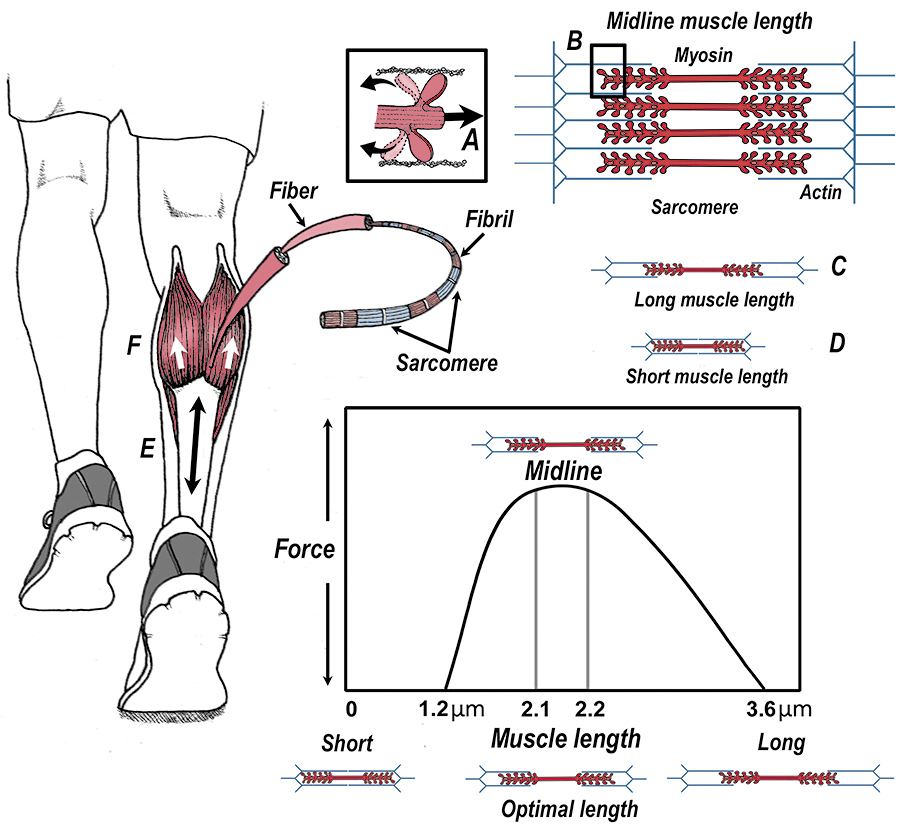
FIG 1 The length/tension relationship in muscles. The basic contractile component of a muscle is called the sarcomere, and it is comprised of actin and myosin subunits that glide upon each other when stimulated by a nerve (A in top box). When a muscle is in a midline position, the majority of actin and myosin filaments overlap perfectly, allowing the muscle to create the greatest amount of contractile force as the maximum number of actin and myosin filaments are in full contact (B). Conversely, when a muscle is fully stretched (C) or shortened (D), there is reduced contact between the actin and myosin filaments, which greatly limits the amount of force a muscle can generate (graph). When a tendon is abnormally compliant (E), the calf muscles are placed in a shortened position (F), which significantly limits force output from the calf muscles.
In addition to injury, a major factor that causes a gradual loosening of the Achilles tendon is age. As we get older, our Achilles tendon fibers become smaller, and the Achilles tendon becomes gradually looser. By the time we are in our 30s and 40s, the age-related loosening of the Achilles tendon results in a significant reduction in force output from the calf muscles that decreases our ability to run fast.
Paquette, et al.,1 recently compared force output in all joints of young and middle-aged runners and determined that the older runners slow down not because of decreased force output in their hips or knees, which remained unchanged, but because of isolated weakness in the calf muscles. This isolated weakness can only be explained by the fact that overly compliant Achilles tendons force the calf muscles to work in their shortened positions, making it impossible for them to generate adequate force output.
The compliance-related decreased force output from the calf muscles gets worse as we get older. According to Gray, et al.,2 people over the age of 70 have 44% less Achilles tendon stiffness than younger adults, which causes a 17% higher net metabolic power while walking. The authors state that in order to prevent age-related decreases in walking and running performance, research is needed to determine which interventions effectively tighten overly compliant Achilles tendons.
The same is true following tendon injury: rather than focusing on increasing calf flexibility, which would just worsen the problems associated with exaggerated tendon compliance, exercise interventions should be performed that increase tendon stiffness.
It turns out there has been a significant amount of research showing that the easiest way to tighten injured and/or aging tendons is to perform heavy-resistance, prolonged isometric contractions.3-4 Isometric contractions can even improve metabolic efficiency while running.
Albrecht, et al., 5 recently had 17 runners perform a simple intervention in which they sat with their hips flexed 40 degrees, their knees extended, and their ankle positioned in 5 degrees of dorsiflexion. In this position, the runners were told to do five sets of four near-full-effort isometric calf contractions, in which they spent three seconds building to peak force and then three seconds relaxing after each contraction.
This exercise was done on both legs, four times per week, for 14 weeks (Fig. 2). At the end of the study, compared to a control group, the group performing isometric contractions had a remarkable 16% increase in Achilles tendon stiffness, which resulted in a 4% reduction in the rate of oxygen consumption while running.
FIG 2 The Albrecht protocol to increase tendon strength. In this protocol, the hip is flexed 40 degrees, the knee is straight, and the ankle is dorsiflexed 5 degrees. While holding the strap firmly, push your forefoot into the strap, spending three seconds building to near peak force, and three seconds gradually decreasing from this force (arrow). You should do five sets of four repetitions on each leg, four times per week for 14 weeks.
Note that this 4% improvement in running economy is equal to or greater than the improved running economy associated with wearing the new carbon-plated running super shoes, which can take 4-6 minutes off of a three-hour marathon.6 Albrecht, et al.,5 relate the improved metabolic efficiency directly to the fact that the isometric contractions stiffen the Achilles tendon, which allow the calf muscles to work in their metabolically efficient midline positions.
While this study evaluated the effect on younger athletes, this exercise routine is also an extremely effective way to improve tendon health and walking efficiency in older adults. Several studies have shown that prolonged isometric contractions, especially when performed with the tendon in a lengthened position, can increase tendon stiffness by as much as 50%.7
Prolonged isometric contractions also serve as an excellent warm-up when treating people with painful tendinopathy. As demonstrated by Rio, et al.,8 a painful tendon causes the central nervous system to decrease motor drive to the tendon, causing muscle weakness and impaired performance during sport. These authors show that performing five, 45-second isometric contractions at 70% full effort results in an immediate and significant reduction in pain that lasts for a minimum of 45 minutes.
When compared to a general warm-up with isotonic contractions, the isometric contractions produced a 6.8/10 reduction in pain scores compared to a 2.6/10 reduction in pain following conventional isotonic exercises. The isometric exercises also improved neural drive to the muscles, resulting in a nearly 19% increase in muscle strength.
Rio, et al.,8 emphasize that in addition to the improved performance associated with increased force output, repeat isometric contractions allow athletes to manage their pain before and after sports participation, decreasing the need for potentially dangerous pharmacological interventions for pain management, such as ibuprofen and/or aspirin.
Isometric contractions are safe, effective and once again prove the old adage, “Exercise is medicine.”
References
Paquette M, DeVita P, Williams D. Biomechanical implications of training volume and intensity in aging runners. Med Sci Sports Exerc, 2018 Mar;50(3):510-515.
Gray AJ, et al. Reduced Achilles tendon stiffness in aging associates with higher metabolic cost of walking. J Appl Psychol, 2024;137(6):1541-1548.
Kubo K, Kanehisa H, Fukunaga T. Effects of different duration isometric contractions on tendon elasticity in human quadriceps muscles. J Phys, 2001;536:649-655.
Oranchuk D, Storey A, Nelson A et al. Isometric training and long-term adaptations: Effects of muscle length, intensity, and intent: a systematic review. Scand J Med Sci Sports, 2019;29:484-503.
Albracht K, Arampatzis A. Exercise-induced changes in triceps surae tendon stiffness and muscle strength affect running economy in humans. Euro J Applied Phys, 2013;113:1605-1615.
Joubert DP, Jones GP. A comparison of running economy across seven highly cushioned racing shoes with carbon-fibre plates. Footwear Sci, 2022 May 4;14(2):71-83.
Kubo K, Ohgo K, Takeishi R et al. Effects of isometric training at different knee angles on the muscle–tendon complex in vivo. Scand J Med Sci Sports, 2006;16:159-167.
Rio E, Kidgell D, Purdam C, et al. Isometric exercise induces analgesia and reduces inhibition in patellar tendinopathy. Brit J Sp Med, 2015;49:1277-1283.
While cervical disc pathology can unquestionably produce radiculopathy, many patients presenting with arm pain, paresthesia or perceived weakness do not exhibit the clinical behavior of true nerve-root compromise. In these cases, failure to differentiate the primary pain generator may lead to unnecessary spinal injections, nerve ablation procedures or surgical consultation despite limited likelihood of benefit.
The New Jersey Board of Chiropractic Examiners has made a precedential decision, concurring with the Association of New Jersey Chiropractors' (ANJC) position paper on chiropractic X-ray guidelines. In plain terms, the board ruled, consistent with the ANJC position, that insurance companies cannot use medical X-ray rules or recommendations, like those written by the American College of Radiology (ACR), to decide whether a chiropractor's X-ray was necessary.
For decades, chiropractors have been told the answer to more professional referrals is simple: educate medical doctors about chiropractic. There is some truth in that advice; but it is also incomplete. The modern challenge is not simply getting another healthcare professional to know that chiropractors exist. It is becoming the kind of clinician (and building the kind of professional relationship) that makes collaboration easy and sustainable.